

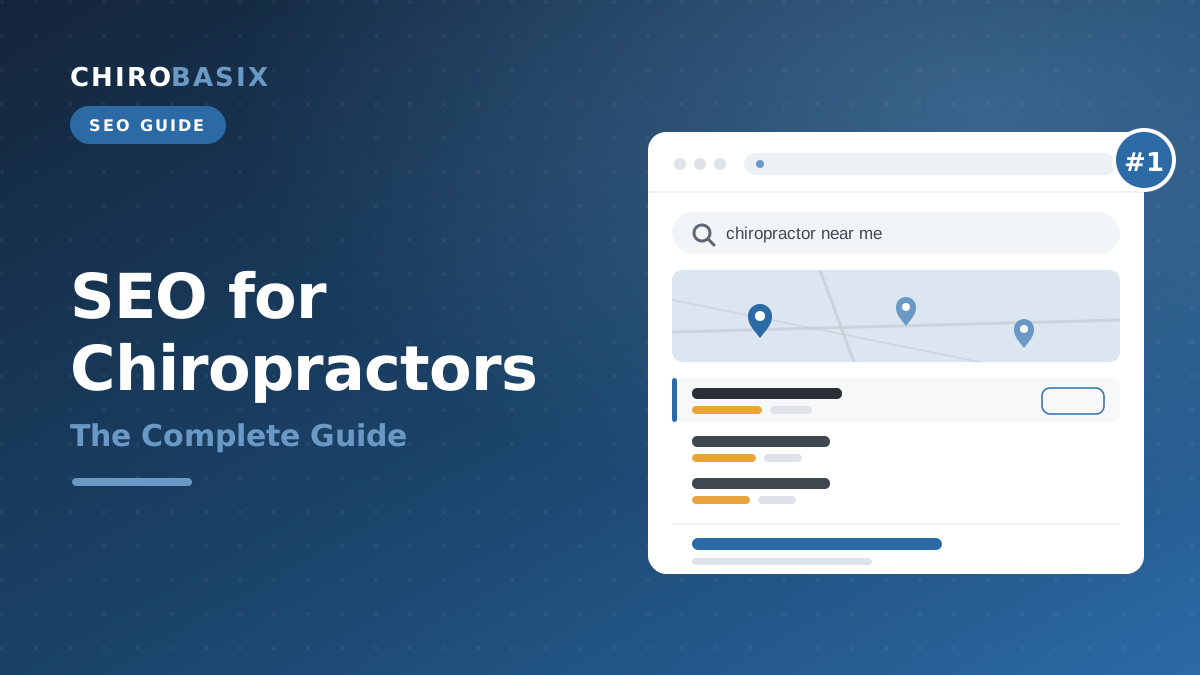
TL;DR: Chiropractic SEO in 90 Seconds
Short on time? Here’s the whole guide in one box:
- There are two games on Google, and you need both. The Map Pack (local 3-pack + Google Maps) captures “chiropractor near me,” and the organic website results below it capture everything else. They have different ranking rules.
- Local SEO wins fastest. A fully-optimized, verified Google Business Profile + a steady flow of reviews is the single highest-ROI move for most practices. Over half of local searches end in the Map Pack.
- Your website needs dedicated pages for every service and symptom you treat, plus educational articles. One thin page won’t rank for the dozens of things patients search.
- Reviews are a ranking signal, not just social proof. Quantity, rating, and recency all push you up the Map Pack.
- AEO is the new frontier. As patients ask ChatGPT and Google AI Overviews “who’s the best chiropractor in [city]?”, the same signals that win SEO get you cited by AI.
- It compounds. Expect movement in ~3 months and real new-patient flow by months 4–6. Unlike ads, the equity keeps building after you stop paying.
Want it handled for you? Our done-for-you chiropractor SEO services cover everything below. Prefer to see the math first? Run your numbers in the Marketing ROI Calculator.
What Is Chiropractic SEO?
SEO stands for Search Engine Optimization: the activities that help your practice show up higher in Google’s search results. Chiropractic SEO is simply SEO applied to the way patients actually look for care: local, urgent, and increasingly voice- and AI-driven.
Showing up at the top of Google is extremely valuable. Google is the number one place people go to find answers, products, and services, and chiropractic care is no exception. When someone tweaks their back or wakes up with sciatica, they go to Google and type “chiropractor near me.” If you’re not in the top results, that patient becomes your competitor’s patient.
This is the best kind of marketing because the demand already exists. These patients have already identified a problem and decided they need help. You just have to be there when they look. That’s why ranking is “low-hanging fruit”: high intent, ready to book.
This guide walks through how to do chiropractic SEO yourself, step by step: local Map Pack, website, keywords, reviews, and the new world of AI answer engines. If you’d rather have it handled for you, our done-for-you chiropractor SEO + AEO services cover everything below.
How Chiropractors Rank Higher on Google
To rank higher, you have to understand the signals Google uses. There are hundreds of factors, but they fall into a few buckets that matter most for a local practice. First, recognize that a Google search results page is split into two distinct sections, and each one is a separate game with its own rules:
- Map Listings (the Map Pack / Google Business Profile): verified local businesses with a claimed profile. These show as pins on Google Maps and as the “3-pack” at the top of local searches. Ranking here is driven by your Google Business Profile, proximity, and reviews.
- Website Results: the organic blue links Google lists to match the search. Ranking here is driven by your website’s content, on-page optimization, technical health, and backlinks.
Google decides local rankings using three core ideas, and it helps to keep them in mind for everything that follows:
| Ranking factor | What it means | How you influence it |
|---|---|---|
| Relevance | How well your practice matches the search | Categories, services, keywords, content |
| Distance | How close you are to the searcher | Service-area accuracy, location pages |
| Prominence | How well-known & trusted you are | Reviews, citations, backlinks, activity |
You can’t change a searcher’s distance, but you have enormous control over relevance and prominence. Let’s dive into each section of the results page.

Local SEO & the Google Map Pack
About 52% of local searches end with a click on a Google Map listing. These listings are severely underutilized by local businesses, which means there’s a huge opportunity to position yourself at the top just by optimizing your Google Business Profile (GBP). For most chiropractors, this is the fastest, highest-ROI part of SEO. Start here.
Local SEO is winnable. In our keyword research, “local seo for chiropractors” and “chiropractic local seo” carry some of the lowest competition scores in the entire niche. The practices that show up are simply the ones that did the unglamorous work consistently.
Complete Your Chiropractic Practice’s Google Business Profile
If you haven’t already claimed your listing, create one at the Google Business Profile website, then fill out everything:
- Business name (exactly as it appears on your signage)
- Primary category: set this to Chiropractor (this single field is a powerful relevance signal)
- Secondary categories (e.g. Sports medicine clinic, Physical therapist) where accurate
- Phone number and website URL
- Physical address and service area
- Hours of operation (including holiday hours)
- Photos: interior, exterior, team, treatment rooms
- Products & Services with descriptions
- The “from the business” description, using natural keywords
Be thorough. Listings that are more complete consistently outrank sparse ones. For a deep, click-by-click walkthrough, see our dedicated Chiropractor’s Guide to Google Business Profile.
Generate More Chiropractic Patient Reviews
Google puts heavy weight on your reputation, so gather reviews relentlessly. Google gives you a direct link to share with patients: text or email it after every appointment. Better yet, automate it so it happens without anyone remembering to. Our chiropractic reputation management service sets up review automation that dramatically increases how many reviews you collect.

The more reviews you have, the better. You can never have too many. Listings with the most (and most recent) reviews typically rank higher, and they give prospective patients the confidence to choose you. Reviews are important enough that they get their own section below.
Claim Citations & Directories (Consistent NAP)
Google crawls the web to confirm your business is legitimate and consistent. The more reputable directories that list you (Yelp, Yellow Pages, Apple Maps, Foursquare, healthcare-specific directories) the better. The single most important rule: your NAP (Name, Address, Phone) must be identical everywhere. A “Street” in one listing and “St.” in another, or an old phone number, creates conflicting signals that hold back your rankings.

If you’ve ever moved offices or changed numbers, you almost certainly have bad listing data out there. Tools like BrightLocal and Yext (covered below) help you find and fix it at scale.
Post Weekly on Your Google Business Profile
You can publish “posts” on your GBP just like a social feed. Do it weekly. We post on our clients’ profiles every week so fresh content is constantly hitting Google, a clear signal that the practice is active and engaged. It’s one of the most overlooked Map Pack tactics; here’s why weekly GBP posts move you up Google Maps.
Geotag Your Chiropractic Photos
Post new photos to your profile regularly, and tag them properly before you do. Use a keyword-focused file name, then run the image through a geotagging tool to embed your practice’s latitude and longitude in the photo metadata. Google reads this and correlates the photo with your location, a small, easy edge most practices skip.
Website SEO for Chiropractors
Below the Map Pack sit the website results, where Google lists the pages it thinks best match the search. Ranking high here matters because most searchers never move past the top 3–5 results. The higher you rank, the more clicks and patients you get. Here’s where to focus.
Build Dedicated Service & Symptom Pages
Your website should have an individual page for every major symptom and service you treat. A single “Services” page that lists everything will never rank for the dozens of specific things patients search. Dedicated pages do three things:
- Give patients a focused place to learn about their specific problem and how you treat it.
- Give Google a specific page to rank when someone searches that exact symptom or service.
- Add depth and context that builds your site’s overall topical authority.
Build out pages for sciatica, lower back pain, neck pain, headaches/migraines, prenatal care, sports injuries, auto-accident care, and each technique you offer. Load them with genuinely useful education, not thin filler. If your current site makes this hard, a custom chiropractic website built for SEO makes adding and structuring these pages far easier, and the right website features matter more than most owners realize.
Publish Educational Content & Articles
Beyond your core pages, publish blog articles that answer real patient questions. Educational content builds authority with Google, targets long-tail searches (“is it safe to see a chiropractor while pregnant?”), and earns the trust of readers who aren’t ready to book yet. A simple, durable content engine: write down the questions patients actually ask you, then answer each one thoroughly. Those questions become your headlines.

Nail Your Titles, Headers & URLs
How your pages are coded matters. Page Titles (the <title> tag) and Header Tags (H1, H2, H3) tell Google what each page is about. Lead each one with the primary keyword for that page, keep every title unique, and use natural variations across your headers. Keep URLs short, lowercase, and keyword-relevant (/services/sciatica-treatment/, not /page?id=412).

Add Local Schema Markup
Schema is structured-data markup that tells search engines exactly what your content means: your practice’s name, address, phone, hours, services, and reviews. Adding LocalBusiness schema helps Google confidently connect your site to your physical location, and it’s increasingly important for getting pulled into rich results and AI answers. You can generate markup with a Schema Markup Generator, or get it built in properly with a purpose-built chiropractic website.
Make Sure the Technical Foundation Is Sound
None of the above matters if the site is slow or broken on a phone. The non-negotiables:
- Mobile-first: the majority of “near me” searches happen on phones. Your site must be fast and effortless on mobile.
- Page speed: compress images, and aim for a fast Largest Contentful Paint. Slow sites lose both rankings and patients.
- Click-to-call & clear CTAs: a tappable phone number and obvious “Book Now” on every page.
- NAP on every page: name, address, and phone in the footer site-wide.
Generate Quality Backlinks
Backlinks, other websites linking to yours, remain one of the strongest signals of website authority. Google sees reputable sites vouching for you and trusts you more. They’re harder to earn than the steps above, but high-impact. Ways chiropractors earn links:
- Build citations and directory listings
- Join your local Chamber of Commerce
- Sponsor local sports teams, races, and events (great for local + links)
- Get featured in local press and on partner businesses’ sites
- Publish genuinely valuable articles and tools people want to cite

Top SEO Keywords for Chiropractors
Before you create content, decide which keywords to target so your effort goes toward terms that actually drive patients. We break down the best keywords for chiropractors, with real search volume and difficulty data for every term, in a dedicated guide. Build a simple spreadsheet and, for each keyword, capture three variations: the base term, the “near me” version, and the location version. Patients search all three.
Here are strong general keywords for a chiropractic office:
| Keyword | Near Me | Location |
|---|---|---|
| Chiropractor | Chiropractor near me | Chiropractor {your city} |
| Chiropractic care | Chiropractic care near me | Chiropractic care {your city} |
| Sports chiropractor | Sports chiropractor near me | Sports chiropractor {your city} |
| Prenatal chiropractor | Prenatal chiropractor near me | Prenatal chiropractor {your city} |
| Pediatric chiropractor | Pediatric chiropractor near me | Pediatric chiropractor {your city} |
| Family chiropractor | Family chiropractor near me | Family chiropractor {your city} |
| Upper cervical chiropractor | Upper cervical chiropractor near me | Upper cervical chiropractor {your city} |
| Wellness chiropractor | Wellness chiropractor near me | Wellness chiropractor {your city} |
And symptom-based keywords, which capture patients describing a problem rather than naming a solution:
| Keyword | Near Me | Location |
|---|---|---|
| Back pain treatment | Back pain treatment near me | Back pain treatment {your city} |
| Neck pain treatment | Neck pain treatment near me | Neck pain treatment {your city} |
| Sciatica treatment | Sciatica treatment near me | Sciatica treatment {your city} |
| Headache treatment | Headache treatment near me | Headache treatment {your city} |
| Hip pain treatment | Hip pain treatment near me | Hip pain treatment {your city} |
| Herniated disc treatment | Herniated disc treatment near me | Herniated disc treatment {your city} |
| Auto accident injury | Auto accident chiropractor near me | Auto accident chiropractor {your city} |
Use a keyword tool (see below) to check real search volume in your area, then build a dedicated page or article for the highest-value terms. Map each keyword to one page so you’re not competing with yourself, a mistake we see constantly, where a practice has three thin pages all targeting “back pain” instead of one strong one.
Reviews & Reputation Signals
Reviews deserve their own section because they pull double duty: they’re a direct local ranking signal and the single biggest driver of whether a searcher chooses you once they see you. Four things about your reviews matter to Google:
- Quantity: how many you have (more is better, always)
- Rating: your average star rating
- Recency: a steady stream beats a burst two years ago
- Velocity: how consistently new reviews come in
The takeaway: review collection should be an always-on system, not an occasional ask. Set up automation that texts or emails every patient after their visit with a direct link to leave a Google review. This is exactly what our reputation management service automates, and it’s usually the first thing we turn on for a new practice.
Responding matters too. Reply to every review, positive and negative, but do it carefully: as a healthcare provider you must respond without confirming someone was a patient or referencing any health details. We wrote a full playbook on responding to Google reviews HIPAA-safely, including copy-paste templates. And if a legitimate review ever disappears, here’s how to reinstate missing Google reviews.
Answer Engine Optimization (AEO) for Chiropractors
Here’s what’s changed since this guide was first written: patients no longer only use a search box. More and more, they ask AI (ChatGPT, Google AI Overviews, Perplexity, Bing Copilot) questions like “who’s the best chiropractor in [city]?” or “is a chiropractor or physical therapist better for sciatica?” Answer Engine Optimization (AEO) is the practice of getting your business cited as the trusted answer inside those AI responses.
The good news: AEO is built on the same foundation as everything above. AI answer engines pull from the same signals that power search:
- A complete, verified Google Business Profile with strong, recent reviews (AI leans heavily on these for “best [service] in [city]” answers).
- Structured data / schema that states your facts unambiguously (name, location, services, hours, ratings).
- Clear, factual, well-organized content that answers real questions directly: FAQ sections, definitions, and step-by-step explanations are especially “quotable” by AI.
- Consistent citations across the web reinforcing who and where you are.
A few AEO-specific moves to layer on top:
- Write in question-and-answer format. Use the actual questions patients ask as headings, and answer them concisely in the first sentence or two. (This guide’s FAQ section is a working example.)
- State facts plainly. “We’re an upper-cervical chiropractor in [city] open Saturdays” is easy for an AI to extract and repeat. Burying that in marketing prose is not.
- Earn mentions, not just links. AI models weigh being talked about across the web (local press, directories, partner sites) even without a clickable link.
AEO isn’t a replacement for SEO; it’s the next layer. The practices investing in it now will own the AI answer box the way early movers owned the Map Pack. Our SEO + AEO program engineers the schema, content, and review signals these engines reward.
SEO Timeline & ROI
The most common question we get: “How long until this works, and is it worth it?” Honest answer: SEO is a compounding asset, not an on/off switch like paid ads (here’s how the two compare for a practice). Here’s a realistic timeline for a typical practice, and if you want the full month-by-month, see how long chiropractor SEO takes to work:
| Timeframe | What’s happening | What you’ll see |
|---|---|---|
| Month 1 | GBP optimization, citation cleanup, review system live, technical fixes | Profile views tick up; foundations set |
| Months 2–3 | Content + service pages published, reviews accumulating, posting weekly | Map Pack movement, first ranking gains |
| Months 4–6 | Authority building, links, momentum on content | Meaningful new-patient traffic from search |
| Months 6–12+ | Compounding rankings, expanding keyword footprint | Predictable, growing flow of patients |
The reason SEO is worth the patience is patient lifetime value. A single new chiropractic patient is often worth $1,500–$2,000+ over their care plan. If SEO brings in even a handful of new patients a month, the return dwarfs the investment, and unlike ads, that equity keeps compounding after you stop actively building it.
Want to model your own numbers? Our free Marketing ROI Calculator lets you plug in your patient value and see the return. Or get a free SEO audit to see exactly where your practice stands today.
Real-world result: Dr. Leland Ferguson of Back Pain Relief Chiropractic told us after working with our team: “Whatever you are doing, keep it up! I’ve never had this many people from the web. This past month I’ve had more new patients than ever before.” Dr. Derrick Pallis put it simply: “Been getting calls from Google and my website just about every day.”
Best SEO Tools for Chiropractors
A handful of tools cover the research, optimization, and reporting you’ll need. Here’s what we actually use with clients:
- Semrush: keyword research, rank tracking, website audits, backlink analysis. The most complete all-in-one.
- BrightLocal: local SEO audits, citation building, Map Pack rank tracking. Built specifically for local.
- Yext: push consistent NAP data across hundreds of directories at once.
- Google Search Console: free, essential. See the exact queries you rank for and your click-through rates.
- Google Analytics: free traffic and conversion tracking.
- Google Keyword Planner: free keyword volume research.
- ENGAGE: our all-in-one CRM for review automation, reputation management, and lead follow-up.
You don’t need all of them on day one. Start free with Search Console + Keyword Planner, add a local tool like BrightLocal as you scale, and bring in Semrush when you’re serious about competitive content.
DIY vs. Hiring a Chiropractic SEO Company
Everything in this guide is something a motivated practice owner can do. The real question is whether you should, and that comes down to time, market competitiveness, and opportunity cost. (For a full breakdown of the numbers either way, see how much chiropractor SEO costs.)
| Do It Yourself | Hire a Chiropractic SEO Company | |
|---|---|---|
| Cost | Tools only (~$0–$200/mo) | ~$750–$3,000+/mo |
| Time required | High, ongoing, hands-on | Low, a few hours of input |
| Speed to results | Slower (learning curve) | Faster (proven playbook) |
| Best for | New practices, low-competition areas, hands-on owners | Busy owners, competitive markets, multi-location |
| Risk | Mistakes cost months | Choosing the wrong agency |
A reasonable middle path: DIY the foundations (claim and optimize your GBP, turn on review requests, fix obvious website issues). Those alone move the needle in less competitive markets. Then bring in help for the ongoing content, link building, and AEO work that’s hard to sustain while running a full practice.
If you do hire, choose a team that specializes in chiropractic. They’ll know your patient journey, your compliance constraints, and your competitors. That’s the entire reason CHIROBASIX exists.
Chiropractic SEO FAQs
How much does SEO cost for a chiropractor? DIY runs $0–$200/month in tools. Done-for-you chiropractic SEO typically ranges from ~$750 to $3,000+/month depending on your market, number of locations, and scope. Judge it against patient lifetime value, not the sticker price.
How long does chiropractic SEO take to work? Expect Map Pack movement around 3 months and real new-patient flow by months 4–6, compounding from there. GBP and reviews move fastest; competitive head terms take longer.
What’s the difference between local SEO and website SEO? Local SEO ranks you in the Map Pack and “near me” searches (driven by your Google Business Profile, reviews, and citations). Website SEO ranks your web pages in the organic results (driven by content, on-page optimization, and backlinks). You need both.
Do Google reviews help chiropractors rank higher? Yes, quantity, rating, recency, and velocity are all local ranking signals, and reviews drive click-through and trust on top of that.
Can I do chiropractic SEO myself? Yes, especially the foundations (GBP, citations, reviews, service pages). The trade-off is time and the ongoing content/link work that competitive markets demand.
What is AEO, and do I need it? AEO (Answer Engine Optimization) gets your practice cited inside AI answers like ChatGPT and Google AI Overviews. It builds on your SEO foundation and matters more every month as patients search with AI.
Rank Higher on Google to Grow Your Practice
One of the most powerful things chiropractors can do to grow is rank high on Google. Patients are already actively searching for chiropractic care. Ranking high simply means more of them find you instead of the practice down the street. The more people who see you, the more patient leads you have to work with, and the more your practice grows.
Start with the foundations: claim and fully optimize your Google Business Profile, turn on a review system, build dedicated service and symptom pages, and keep your NAP consistent everywhere. Layer in content, links, and AEO over time, and the results compound.
If you’d like to know exactly where you stand right now, grab a free SEO audit. And if you’d rather have the whole thing handled (search, Map Pack, and AI) our chiropractor SEO + AEO services are built for exactly that. Either way, the patients are out there searching. Let’s make sure they find you.
Keep reading

Facebook Lead Quality for Chiropractors: Why More Leads Can Mean Fewer Patients
More Facebook leads is not the same as more patients. Here is the 6-step friction ladder for trading lead volume for lead quality, and how to pick the right step for your practice.
AEO & GEO for Chiropractors: How to Get Your Practice Recommended by AI
AEO and GEO are two names for one goal: getting your practice cited and recommended inside AI answers. Here's the practice-focused hub guide, built on your SEO foundation.
GEO vs SEO for Chiropractors: What's the Difference?
SEO gets your practice ranked. GEO gets it cited inside the AI answer. Here's how they differ, where they overlap, and why chiropractors need both in 2026.
Want this kind of strategy built for your practice?
Book a free consultation. We'll audit your current marketing and map out the omnipresence plan for your local market.
Book A Free Consultation