

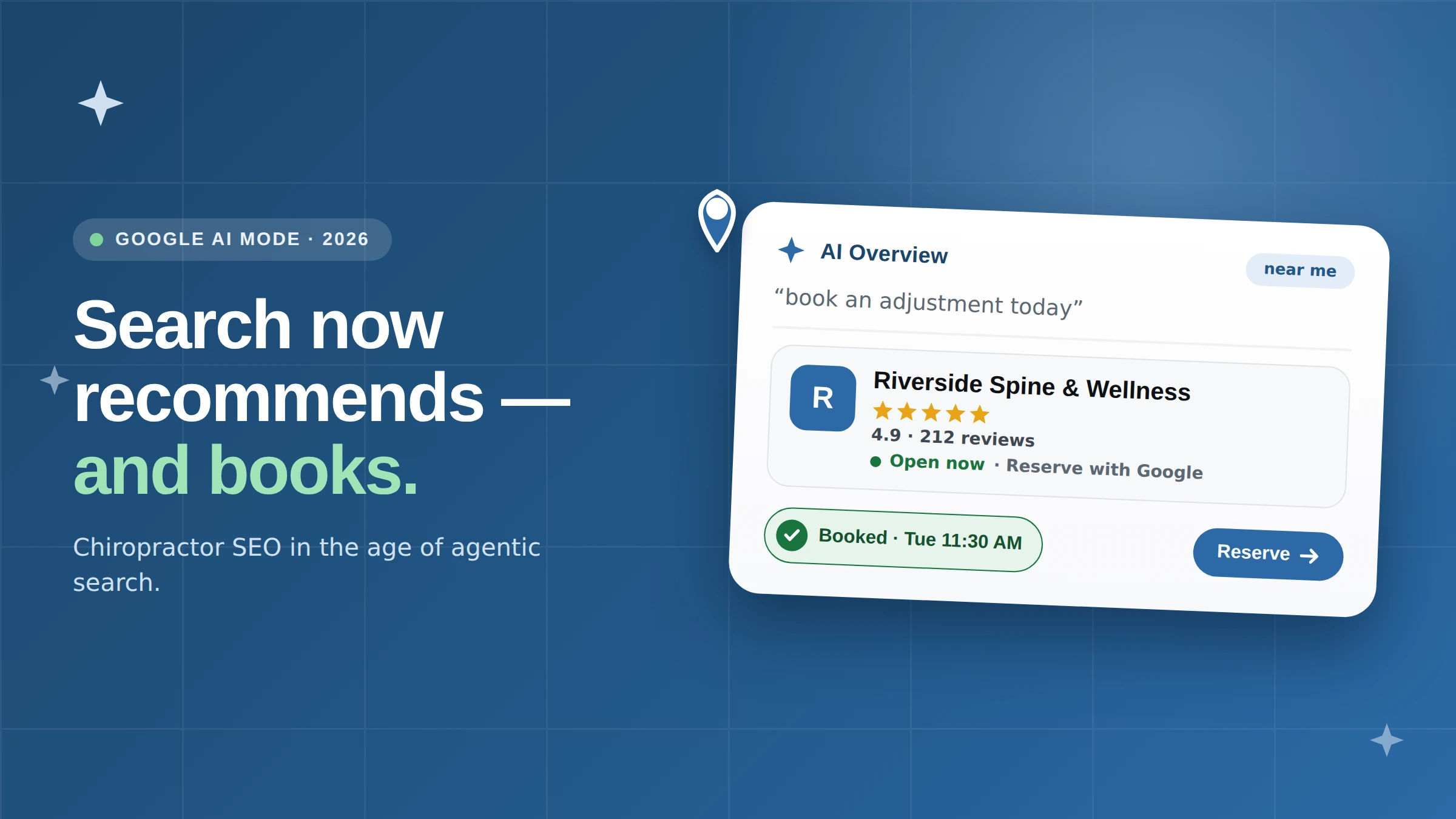
TL;DR - Google AI Mode in 60 seconds:
- AI Mode has passed one billion monthly users (Google I/O, May 2026), and Google said its new booking and business-calling features would reach everyone in the U.S. in summer 2026.
- Chiropractic is squarely in the blast radius: you’re a local, health, appointment-based service, a natural fit for the new booking features.
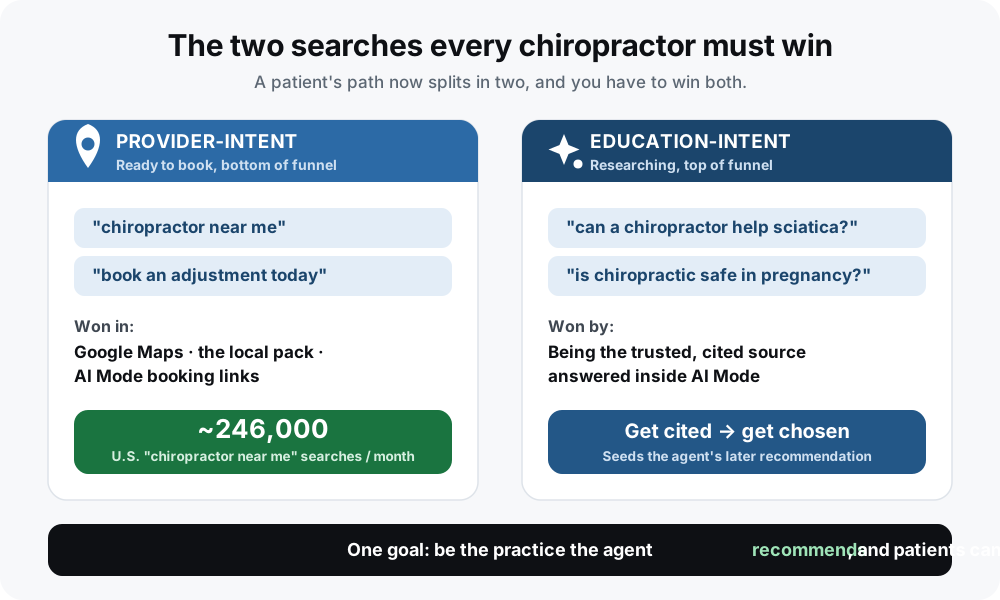
- There are now two searches to win: provider-intent (“chiropractor near me”) and education-intent (“can a chiropractor help sciatica?”).
- The new goal: be the practice the agent trusts enough to recommend, and the patient can book online in a few taps.
- Top priority: connect real-time online booking to your Google Business Profile, keep that profile fresh, and build a steady stream of recent reviews. Then layer on schema, provider credentials, and answer-first content.
A patient opens Google and types “book an adjustment today.” They never see a list of ten blue links. Instead, Google’s AI reads the reviews and live availability of nearby practices, recommends one, and hands them a link to book, all on a single screen. That practice could be yours. Or it could be the chiropractor down the street.
This isn’t a forecast. AI Mode passed one billion monthly users just one year after launch, according to Google’s May 2026 I/O announcement. At the same event, Google announced new agents that don’t just answer questions: they pull the latest pricing and availability for local services, link straight to booking, and, for select categories like home repair, beauty and pet care, even call businesses on the customer’s behalf. For chiropractors, that changes how new patients find you, and it rewrites what chiropractor SEO actually means.
This guide breaks down what Google AI Mode means for chiropractor SEO in 2026: why your practice is more exposed to this shift than almost any other local business, and the eight highest-impact moves to keep your chiropractic SEO working when search starts recommending a practice and linking the patient straight to booking.
What changed at Google I/O 2026
In May 2026, Google made its newest AI model the default engine behind AI Mode for everyone, globally, and gave the search box itself its biggest upgrade in over 25 years. You still get traditional results, but more and more searches now open with a synthesized AI answer pulled from across the web plus Google’s own real-time data: reviews, Maps, business profiles, and live availability.
The bigger shift is that Google’s AI no longer just answers. It acts:
- It monitors. Background agents track topics around the clock and surface what’s new.
- It sends patients to book. For local services, the agent pulls live availability and pricing and hands the patient a direct link to finish booking with the provider.
- It calls. For select categories like home repair, beauty and pet care, people can ask Google to call businesses for them, and AI Mode calls to get details like the earliest open appointment when they aren’t online.
Google said at I/O that these booking and calling features would roll out to everyone in the U.S. in summer 2026, and as of September 2026, Google’s AI Mode help page describes AI Mode finding open appointment slots and calling businesses directly when the details aren’t online. The takeaway for your practice: the patient’s decision increasingly happens inside Google, often before they ever click a website.
Why this matters more for chiropractors than most businesses
Most coverage of AI search talks about e-commerce or publishers. Chiropractic is different, and more exposed, because your practice sits at the exact intersection the new agents were designed for: you are local, you provide a health service, and you run on appointments. That’s a natural fit for Google’s new booking features.
It also means a patient’s path now splits into two distinct searches, and you have to win both.
The two searches every chiropractor must win
Provider-intent searches: “chiropractor near me,” “book an adjustment today,” “walk-in chiropractor open now.” “Chiropractor near me” alone draws roughly 246,000 U.S. searches every month (Semrush data, September 2026), and that demand is exactly what AI Mode’s new booking links are built to serve. These are bottom-of-funnel, ready-to-book moments. They’re won in Google Maps and the local pack, and now through AI Mode’s booking links, where the agent recommends a nearby practice and sends the patient straight to its booking page. Google has shown it tends to keep these local “near me” health searches in Maps-and-local-pack territory rather than a generic AI summary, which makes your Business Profile, your reviews, and your bookability decisive.
Education-intent searches: “can a chiropractor help sciatica?,” “is chiropractic safe during pregnancy?,” “chiropractor vs. physical therapist for back pain.” These are research moments answered directly inside AI Mode. You win them by being a trusted, cited source, which seeds your practice into the consideration set the agent draws on later when the same patient is ready to book.
Different searches, one goal: be the practice the agent recommends, and the patient can book online in a few taps.
Traditional search vs. agentic search: what actually changed
| Dimension | Traditional Google Search | Agentic Search (AI Mode) |
|---|---|---|
| What the patient sees | Ten blue links to scroll through | One synthesized answer or a single recommendation |
| How you win | Rank on page one | Be the source the AI trusts and cites |
| Where the decision happens | On your website, after a click | Inside Google, often before any click |
| How booking works | Patient finds your site, then books | The agent shows live availability and links straight to booking, or calls for details that aren’t online |
| Signals that matter most | Keywords, backlinks, on-page SEO | Reviews, real-time availability, structured data, credentials, entity trust |
| Your biggest risk | Ranking #3 instead of #1 | Being invisible to the agent entirely |
The shift in that last row is the one to sit with. In the old model, a mediocre SEO setup meant fewer clicks. In the new model, an incomplete profile or a scheduler the agent can’t read can mean zero. The patient never knows you exist.
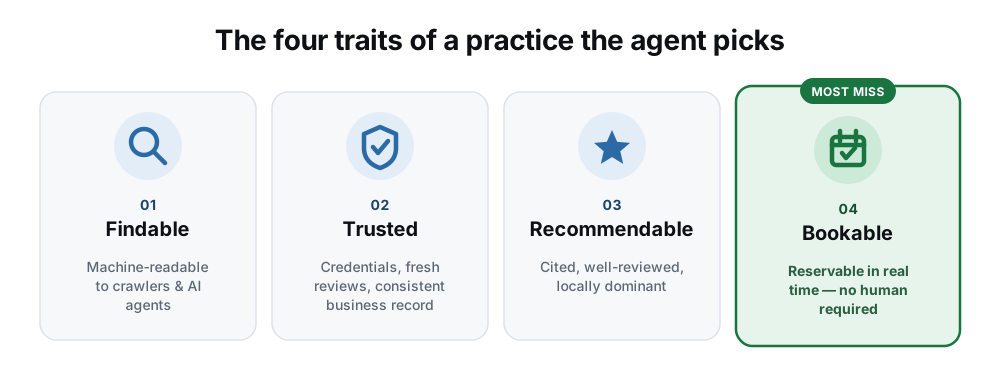
The four traits of a practice the agent picks
Every tactic that follows maps to one of four traits. If your practice has all four, the agent can find you, trust you, recommend you, and send the patient to book you.
- Findable: machine-readable to crawlers and AI agents. If they can’t access or parse your site and profile, nothing else counts.
- Trusted: credentials, recent reviews, and a clean, consistent business record across the web. Health is held to a higher bar (more on that below).
- Recommendable: cited in answers, well-reviewed, and locally dominant. This is what earns the agent’s recommendation.
- Bookable: reservable in real time, with no human required. This is the trait most practices are missing.
The 8 moves that keep your practice visible
Highest impact first. Audit your own practice against each of these this week.
| # | Move | Why it wins in AI search |
|---|---|---|
| 1 | Connect real-time online booking to your Google Business Profile | If the agent can’t see your live availability, it’s more likely to send the patient to a competitor it can. This is the single biggest new lever. |
| 2 | Turn your Google Business Profile into a live data record | It’s the canonical record the agent reads for local searches. Complete every field, fix your category, add services and hours, post weekly, and keep your map pin precise. |
| 3 | Build a steady review engine | Recency and sentiment, not just your star count, drive who gets recommended. A trickle of fresh, specific 5-star reviews compounds into map-rank lift. |
| 4 | Get agentic-call ready | In some categories, AI Mode already calls businesses when details like the next open appointment aren’t online. If it ever calls you, voicemail or a slow desk loses that patient. An AI receptionist or reliable phone coverage protects it. |
| 5 | Publish transparent pricing | Clear service prices on your site and profile help the agent surface you as a concrete match (“new-patient exams at $49, open today”). |
| 6 | Add structured data (schema) | Schema tells the machine exactly what you are (a credentialed chiropractor, with a specialty, a rating, and bookable services), so you’re reliably citable and recommendable. |
| 7 | Strengthen provider authority (E-E-A-T) | Health content is held to the highest trust bar. Real provider bios with credentials, licenses, and schooling are your strongest authority signal. |
| 8 | Write answer-first content | Self-contained, question-led answers are what the AI lifts and cites. Lead each section with a one-sentence answer, then explain. |
We go deeper on several of these in our guides to keeping your Google Business Profile ranking, building a chiropractic review engine, and getting agentic-call ready with a 24/7 AI receptionist.
How it fits together: trusted to recommend, frictionless to book
Think of these eight moves as two halves of one system.
The authority side (E-E-A-T provider pages, answer-first content, fresh reviews, and schema) is what gets your practice recommended. It’s how you become the answer when a patient asks whether chiropractic can help their problem, and the name the agent surfaces when it’s time to choose a provider.
The booking side (a connected scheduler, a live Business Profile, and a phone that’s actually answered) is what closes the patient. It’s how the patient goes from “Riverside Spine is a strong match” to “Booked, tomorrow at 11:30.”
You need both halves. A practice with great content but no real-time booking gets recommended and then loses the patient at the finish line. A practice that’s perfectly bookable but invisible in answers never gets recommended in the first place. One without the other leaks patients.
One practical note worth checking today: most chiropractic scheduling and patient-engagement software does not natively connect to Google’s booking the way a true Reserve with Google partner does. “Online scheduling” on your own website is not the same as a Book button inside Google itself. Confirm whether your system is an actual Google booking partner. It’s the difference between Google seeing your live openings, with a Book button inside Google, and just having a link on your profile.
How to write content AI will actually cite
Because the “education-intent” half of the battle is won inside AI Mode, it’s worth being specific about how to structure content the AI will lift. Three rules carry most of the weight:
- Write the question, then answer it in one sentence. Make your H2 the exact question a patient asks, “Can a chiropractor help sciatica?”, and open with a direct, self-contained answer before you elaborate. For many patients, chiropractic care may help relieve sciatica by easing pressure on the affected nerve over a short course of visits. That kind of clean, liftable sentence is what gets cited.
- Be specific and accurate. AI systems favor content with concrete, verifiable detail, and health content especially must align with accepted clinical guidance. Vague or overstated claims get passed over, and can hurt your trust signals.
- Make it machine-readable. Add FAQ and medical/business schema, give every provider a credentialed byline, and label your images and video so the agent can parse them. Original photos, real patient education, and a genuine provider point of view all help you stand out from the templated content flooding the web.
I show what a short, citable answer looks like in my Google and AI search training, starting at 43:02.
This is the same answer-engine work behind our chiropractic SEO and AEO service, and we break down the broader playbook in our ultimate SEO guide for chiropractors. For the practical, signal-by-signal version, see how to get your practice cited by AI.
Frequently asked questions
What is Google AI Mode? Google AI Mode is Google’s AI-powered search experience that answers questions with a synthesized response drawn from the web and Google’s real-time data, and can increasingly take actions for the user, like finding open appointment slots or calling a business for details.
Does AI Mode replace SEO for chiropractors? No. AI Mode is built on Google’s core search and ranking systems, so strong SEO fundamentals still matter. What changes is the goal: instead of ranking to earn a click, you’re optimizing to be the trusted source the AI cites and the practice it sends patients to book with.
Can Google really book appointments for my chiropractic practice? Partly. Google’s AI Mode pulls live availability and pricing and gives the patient a direct link to finish booking with the practice they choose. To show up there, your scheduling system needs to feed real-time availability to Google through a supported booking integration.
Will Google call my front desk to book patients? Not to book, for now. Google can call businesses in select categories like home repair, beauty and pet care, and AI Mode calls when details like the earliest open appointment aren’t online. Keep that information online and your phone answered, so any call gets a quick answer.
How do chiropractors show up in AI search results? By being findable, trusted, recommendable, and bookable: a complete and fresh Google Business Profile, a steady stream of recent reviews, credentialed provider pages, structured data, answer-first content that directly addresses patient questions, and real-time online booking connected to Google.
Do I need to publish my prices? It’s strongly recommended. Transparent pricing on your website and Business Profile gives the agent a concrete reason to surface you as a match and reduces friction for the patient. Keep prices consistent across your site and profile, and follow your state board’s advertising rules.
How soon will this affect my practice? It already can. The AI answer layer is live worldwide, Google announced its booking and calling features for a U.S. rollout in summer 2026, and its help page now describes AI Mode calling businesses and finding open appointment slots. Get your profile, reviews, and booking ready now, before competitors do.
The bottom line: chiropractor SEO is now an agent game
Search has stopped being a list and started being a recommendation, with a direct path to booking. For chiropractors, that’s not a threat to fear but a gap to close before the practice across town does. The winners won’t be the ones with the most AI-generated content. They’ll be the practices that are easy for Google’s agents to trust and easy to book.
Want to know where the agents can already see you, and where you’re invisible? Get your free Agent-Ready Audit and we’ll grade your practice and send you a report card on what to fix first.
Keep reading
Facebook Lead Quality for Chiropractors: Why More Leads Can Mean Fewer Patients
More Facebook leads is not the same as more patients. Here is the 6-step friction ladder for trading lead volume for lead quality, and how to pick the right step for your practice.
AEO & GEO for Chiropractors: How to Get Your Practice Recommended by AI
AEO and GEO are two names for one goal: getting your practice cited and recommended inside AI answers. Here's the practice-focused hub guide, built on your SEO foundation.
GEO vs SEO for Chiropractors: What's the Difference?
SEO gets your practice ranked. GEO gets it cited inside the AI answer. Here's how they differ, where they overlap, and why chiropractors need both in 2026.
Want this kind of strategy built for your practice?
Book a free consultation. We'll audit your current marketing and map out the omnipresence plan for your local market.
Book A Free Consultation