
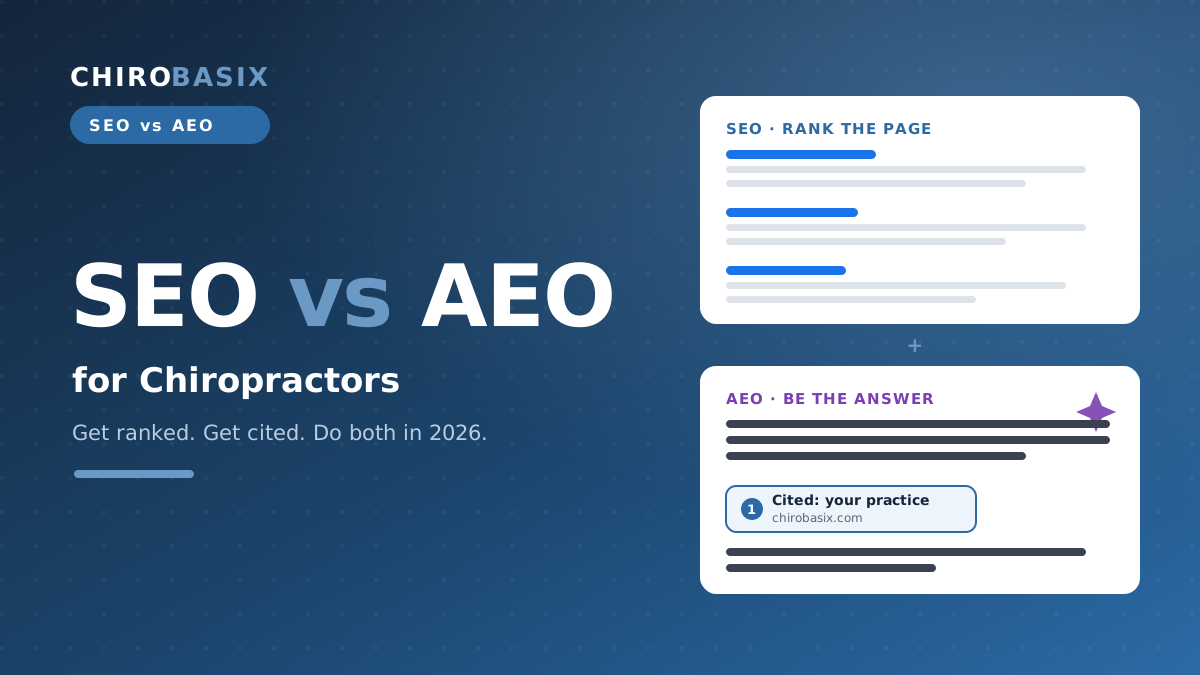
SEO (search engine optimization) gets your pages ranked so a patient clicks through to your site. AEO (answer engine optimization) gets your practice cited as the answer inside AI tools like Google’s AI Overviews, ChatGPT, and Perplexity. SEO earns the click; AEO earns the mention. In 2026, a chiropractor needs both, and they share the same local foundation.
If you’ve heard “AEO” thrown around and quietly wondered whether SEO is dead, let me put your mind at ease: it’s not. But the way patients search has changed, and the practices that understand the difference between SEO and AEO are the ones showing up when someone asks their phone, “who’s a good chiropractor near me for sciatica?” This guide breaks down exactly what each one is, how they differ, and the practical playbook to win both, without an enterprise marketing budget.
The Search Shift You Can’t Ignore
Here’s the reality every practice owner needs to sit with. According to SparkToro’s 2026 zero-click study, 68% of U.S. Google searches ended without a click in the first four months of 2026, up from about 60% in 2024. People are getting their answer on the results page, often from an AI-generated summary, and never visiting a website at all. In Google’s AI Mode it’s even more extreme: Semrush’s 2025 AI Mode study of U.S. desktop searches found 92% to 94% of sessions ended without a visit to any outside website.
At the same time, patients are asking full questions to AI assistants. OpenAI said in August 2026 that ChatGPT has more than 1 billion weekly active users. And a growing share of “find me a provider” research now starts inside an AI tool instead of a search bar. When a prospective patient asks ChatGPT or Google’s AI Overview to recommend a chiropractor, one of two things happens: your practice gets named, or your competitor does.
That’s the shift. Classic rankings still matter enormously, but ranking is no longer the whole game. You also have to be the thing the AI quotes.
What Is SEO for a Chiropractic Practice?
SEO (search engine optimization) is the practice of getting your web pages to rank in Google’s standard results so patients click through to your site. For a local chiropractor, that has always meant two battlegrounds: the Google local pack (the map with three listings) and the organic “blue link” results below it.
SEO optimizes for position: landing in the top few results for searches like “chiropractor near me,” “sciatica chiropractor [your city],” or “prenatal chiropractic care.” The levers are familiar: relevant keywords, a fast and mobile-friendly website, quality content, local citations and backlinks, and a fully optimized Google Business Profile.
SEO is not going anywhere. It’s still how the majority of patients discover a practice, and, as you’ll see, it’s also the foundation your AEO strategy is built on. But it’s now one half of the picture instead of the whole thing.
What Is AEO (and Where GEO Fits)?
AEO (answer engine optimization) is the practice of structuring your content so AI answer engines select, extract, and cite it as the answer. Instead of competing only for a ranking position, you’re competing to be included in, and quoted by, Google AI Overviews, Google AI Mode, ChatGPT, Perplexity, and Microsoft Copilot.
The distinction that matters: SEO optimizes the page, AEO optimizes the passage. AI engines don’t quote your whole article. They pull a specific, self-contained chunk that cleanly answers the question. So AEO rewards clear, extractable answers, structured data, and trust signals rather than keyword density alone.
You’ll also hear GEO (generative engine optimization). In practice, GEO and AEO overlap almost completely; the useful way to think about it is AEO = get cited as the answer, GEO = shape the narrative the AI generates about you. For a chiropractor, treat AEO as the umbrella term and don’t lose sleep over the acronym soup. We go deeper on the distinction in GEO vs SEO for chiropractors, and cover the whole discipline end-to-end in the AEO & GEO guide for chiropractors.
SEO vs AEO: Side-by-Side
Here’s the cleanest way to see the difference:
| SEO | AEO | |
|---|---|---|
| Goal | Rank your page so patients click | Get your practice cited as the answer |
| Where you appear | Blue links + local pack | AI Overviews, ChatGPT, Perplexity, Copilot |
| What gets optimized | The page (site-wide) | The passage (a specific answer) |
| Primary success metric | Rankings & organic clicks | Citations & “share of model” |
| Key levers | Keywords, links, technical health, GBP | Extractable answers, schema, entity trust |
| How patients find you | They search, then choose | The AI recommends a shortlist |
Notice the last row. With SEO, the patient does the choosing. With AEO, the AI narrows the field for them, and if you’re not on the shortlist, a great ranking won’t save you.
How AI Engines Decide Who to Recommend
This is where AEO stops being abstract. AI answer engines work through retrieval-augmented generation: they run your query (often several sub-queries), retrieve candidate passages from across the web, then synthesize an answer citing a few trusted sources. A few things determine whether one of those sources is you:
- Rankings still feed citations, but not only for your main keyword. Ahrefs’ 2026 AI Overview citation study looked at 4 million URLs cited in Google’s AI Overviews and found 38% also rank in Google’s top 10 for the same search, down from about 76% in its July 2025 study. Ahrefs thinks Google is leaning more on pages that rank for the related searches it runs behind the scenes. Translation: strong SEO still feeds AEO and isn’t a competitor to it, but ranking for one keyword is no longer enough. You need pages that answer the related questions patients ask, too.
- Accessibility is a hard gate. A page that’s blocked to AI crawlers, buried behind JavaScript, or erroring out simply cannot be cited.
- Third-party corroboration wins locally. Engines favor businesses described consistently across many trusted sources: your Google Business Profile, directories, and review platforms. For a local practice, being mentioned elsewhere often matters more than on-site tweaks.
- E-E-A-T and trust are non-negotiable for health. Chiropractic is “your money or your life” (YMYL) content, so AI systems apply extra scrutiny. A named doctor with real credentials, verified facts, and zero unverifiable medical claims is both an SEO requirement and a direct AEO advantage.
Why Chiropractors Need Both
Here’s the good news for local practices, and it’s genuinely encouraging: for a chiropractor, SEO and AEO share the same foundation far more than they do for a national brand.
Think of it as the same house with a second front door. The signals that win the local pack (a complete, verified Google Business Profile, identical NAP (name, address, phone) everywhere, and a steady stream of recent reviews) are the exact same signals an AI assistant leans on when a patient asks it to recommend a chiropractor. Invest once in that foundation and you improve your odds in both places at the same time.
What’s genuinely new is that patients now ask full-sentence questions to AI: “Is chiropractic safe during pregnancy?” “How much does an adjustment cost without insurance?” “Can a chiropractor help my sciatica?” Those map perfectly onto a well-built FAQ, and answering them accurately, with a credentialed byline, is the AEO play. You don’t need a new marketing category. You need to do your local SEO well and make your best answers easy for a machine to quote.
I make the same point in my Google and AI search training, starting at 45:59: Google, ChatGPT and Gemini look at a lot of the same trust signals.
The Do-Both Playbook (8 Moves)
Here’s the practical, execute-this-week version. None of it requires an enterprise stack:
- Nail the shared foundation. Fully complete and verify your Google Business Profile, make your NAP identical across your site, GBP, and every directory, and keep recent Google reviews flowing. This one move powers both the map pack and AI recommendations.
- Ship the right schema. Add
LocalBusiness/Chiropractic+PhysicianJSON-LD with verified NAP, and never hand-roll it. This is how machines confirm your facts. - Lead every key page with a definition. Put a plain-language, ~40–60 word answer directly under the headline. That block is what an AI extracts and quotes.
- Build a real patient FAQ. Answer the questions patients actually ask AI, in 30–50 words each, and mark it up with
FAQPageschema. - Publish differentiated condition and service pages (“chiropractic for sciatica,” “prenatal chiropractic”) with a credentialed author byline and a dated “last updated.” Make them genuinely useful, not thin doorway pages.
- Earn off-site presence. Directories, local and health citations, reviews, and, where it’s authentic, YouTube and community mentions. This third-party corroboration is often the biggest local AEO lever.
- Keep classic SEO doing its job. Rankings, site speed, mobile experience, and local links still matter. In Ahrefs’ 2026 study, 38% of pages cited in AI Overviews ranked in Google’s top 10 for the same search, more than the pages ranked 11 through 100 combined. Good SEO feeds your AEO.
- Measure differently. Track not just rankings and clicks, but whether your practice appears in AI Overviews and assistant answers, plus the calls and bookings that follow. Many AEO wins are zero-click, so bookings are your truest scoreboard.
Want the deeper local-SEO fundamentals behind step 1? Start with our complete SEO guide for chiropractors. Ready to go all-in on the AI side? Our playbook on winning Google’s AI Search in 2026 picks up where this leaves off.
SEO vs AEO FAQs
Is AEO replacing SEO for chiropractors? No. AEO layers on top of SEO. It doesn’t replace it. Ahrefs’ 2026 data shows 38% of pages cited in Google’s AI Overviews also rank in the top 10 for the same search. Strong SEO still feeds AEO, but it isn’t enough on its own. You need both working together.
What is answer engine optimization (AEO)? Answer engine optimization is the practice of structuring your content so AI answer engines (Google AI Overviews, ChatGPT, Perplexity, and Copilot) select, extract, and cite your practice as the answer to a patient’s question, rather than just ranking a blue link.
How do I get my chiropractic practice recommended by ChatGPT or AI Overviews? Complete and verify your Google Business Profile, keep your name, address, and phone identical everywhere, earn recent reviews, and publish clear question-and-answer content with schema. AI engines lean heavily on these trusted, consistent local signals when building a shortlist.
Does AEO help me show up in the Google local pack? Yes, indirectly. AEO and the local pack share a foundation: a verified Google Business Profile, consistent NAP, and strong reviews. Strengthening those signals improves your map-pack ranking and your odds of being named in an AI assistant’s recommendations.
What schema does a chiropractor need for AEO? At minimum, LocalBusiness or Chiropractic and Physician JSON-LD with verified NAP, plus FAQPage schema on question-and-answer content and Article schema with a credentialed author. Schema disambiguates your facts for machines so they can cite you confidently.
SEO vs AEO: which should a chiropractor prioritize first? Start with the shared local foundation: a verified Google Business Profile, consistent NAP, and recent reviews. That single investment powers both classic rankings and AI recommendations, so it’s the highest-leverage first move before anything AEO-specific.
The Bottom Line for Chiropractors
SEO and AEO aren’t rivals, and you don’t have to choose. SEO gets you found; AEO gets you quoted. For a local chiropractic practice, they run on the same fuel: a verified Google Business Profile, consistent information everywhere, real reviews, and clear, credentialed answers to the questions patients are actually asking. Do that foundation well, make your best answers easy for a machine to lift, and you’ll show up in both the map pack and the AI’s shortlist. That’s how you stay visible while the rest of the industry is still arguing about acronyms.
Want help getting your practice cited by AI and ranked in Google? Our done-for-you chiropractor SEO & AEO services are built for exactly that. Book a free consultation and let’s talk.
Keep reading
Facebook Lead Quality for Chiropractors: Why More Leads Can Mean Fewer Patients
More Facebook leads is not the same as more patients. Here is the 6-step friction ladder for trading lead volume for lead quality, and how to pick the right step for your practice.
AEO & GEO for Chiropractors: How to Get Your Practice Recommended by AI
AEO and GEO are two names for one goal: getting your practice cited and recommended inside AI answers. Here's the practice-focused hub guide, built on your SEO foundation.
GEO vs SEO for Chiropractors: What's the Difference?
SEO gets your practice ranked. GEO gets it cited inside the AI answer. Here's how they differ, where they overlap, and why chiropractors need both in 2026.
Want this kind of strategy built for your practice?
Book a free consultation. We'll audit your current marketing and map out the omnipresence plan for your local market.
Book A Free Consultation