


TL;DR: Referred patients are the highest-converting, lowest-cost new patients a chiropractic practice can get. They arrive pre-sold and trusting. Yet most practices leave them on the table because they never ask. Build a referral system: ask directly (referral cards, email campaigns, and automated text forms), incentivize participation, plant the seed at the first visit, thank every referrer personally, and back it all with care worth talking about. Then widen the funnel with a professional referral network (PCPs, physical therapists, and personal-injury attorneys) and track every referral so you know what’s working. One caveat before you reward anyone: referral incentives are regulated. Make sure yours are legal in your state.
Chiropractic practices heavily rely on patient referrals. Patients who are referred in by your existing patients are also typically your best new patients. Someone who arrives on a referral is already primed for chiropractic care and trusts that it will be beneficial, so they convert faster, follow their care plan, and stick around longer than a cold lead from an ad ever will.
Every single patient that you see has the potential to be a referral machine. Their network of people that they know is a lot larger than you think. There are going to be people within their circle of influence who can use chiropractic care today. And there are likely going to be more opportunities in the future within their circle: injuries, pregnancies, family members going through health problems, and more.
So how do you turn your existing patients into raving fans who refer their circle to you? It isn’t luck. It’s a system. Below we break down every component of a referral machine, how the methods compare, how to keep the whole thing legal, and how to automate it so it runs without you having to remember.
Chiropractic Referral Methods, Compared
Here are the main ways practices generate referrals, and how they stack up on effort, cost, and whether you can put them on autopilot:
| Method | Setup effort | Cost | Can you automate it? | Best for |
|---|---|---|---|---|
| Just asking (in person) | Low | Free | ❌ Manual | Every practice, start today |
| Referral cards | Low | 💲 Printing | ❌ Manual | In-person, face-to-face hand-offs |
| Email referral campaigns | Medium | 💲 Email tool | ✅ Set & repeat | Activating your existing patient list |
| Digital / text referral forms | Medium | 💲💲 CRM | ✅ Fully automatic | Scaling without adding staff effort |
| Referral incentives | Medium | 💲💲 Rewards | ⚠️ Partly | A short-term referral push |
| Professional network (PCPs, PTs, attorneys) | High | ⏳ Time | ❌ Relationship-based | Steady, high-value referrals |
No single method wins. The best referral engines stack several of them. Start with the free, do-it-today tactics (asking and cards), layer on the automated ones (email and text forms), and build the professional network in the background for the long game. Here’s how to run each one well.
Build a Chiropractic Referral Program (the 6-Part System)
A chiropractic referral program is just a repeatable system for turning happy patients, and referring providers, into a steady, trackable stream of new patients, instead of hoping word-of-mouth happens on its own. Every program that actually works is built from the same six parts:
- Ask for referrals directly: in person and through automated follow-ups.
- Incentivize participation (compliantly, see the legal section below).
- Plant the seed at the very first visit.
- Thank every referrer personally.
- Deliver care worth talking about.
- Widen the funnel with a professional referral network.
Most referral programs that fizzle out fail for one of three reasons: the practice never actually asks, it rewards referrals in a way that isn’t compliant, or it doesn’t track anything, so it can’t tell what’s working or who to thank. Fix those three and you’re already ahead of most practices. Here’s how to run each part of the program well.
1. Ask For The Referral
This is the step that most chiropractic practices skip. They assume patients are going to think of referrals on their own and don’t bother asking. Patients do not know that you want referrals. They are not even thinking about it because they are focused on their own problems. So the first step is to ask. Communicate with your patients about referring and it will start to happen, and you can ask in a way that doesn’t damage your relationship with them or your reputation as a Doctor.
Position your referral request in a way that you’re trying to help people. Using phrases like “if you know anyone who is struggling or could use some help” sets the tone that you’re not just trying to get more business but instead genuinely want to be helpful for people who are suffering. You don’t want to sound desperate for business. Instead, focus on a tone that shows you actually want to help people.
Here are some great ways to promote the idea of patient referrals:
Patient Referral Cards
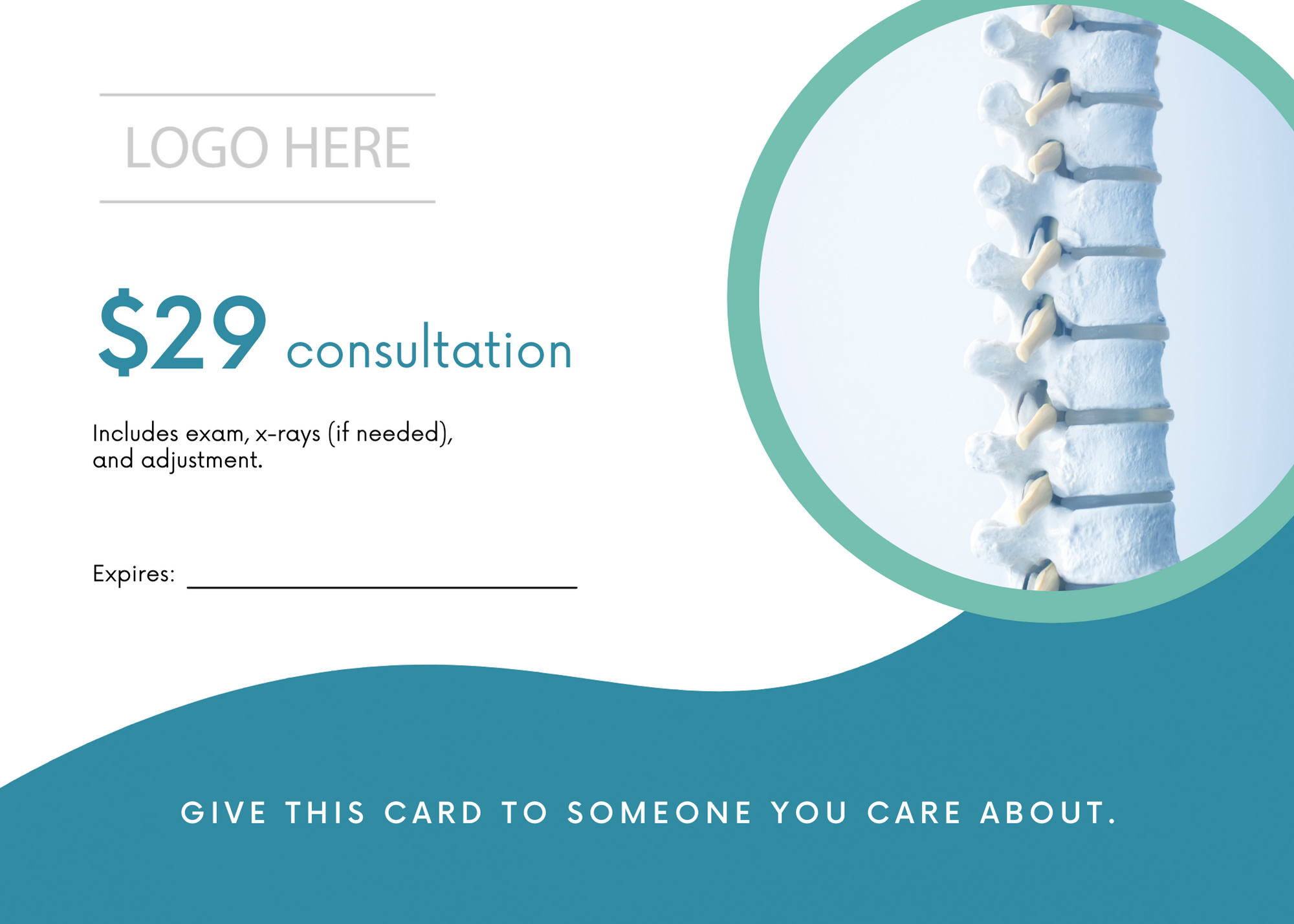
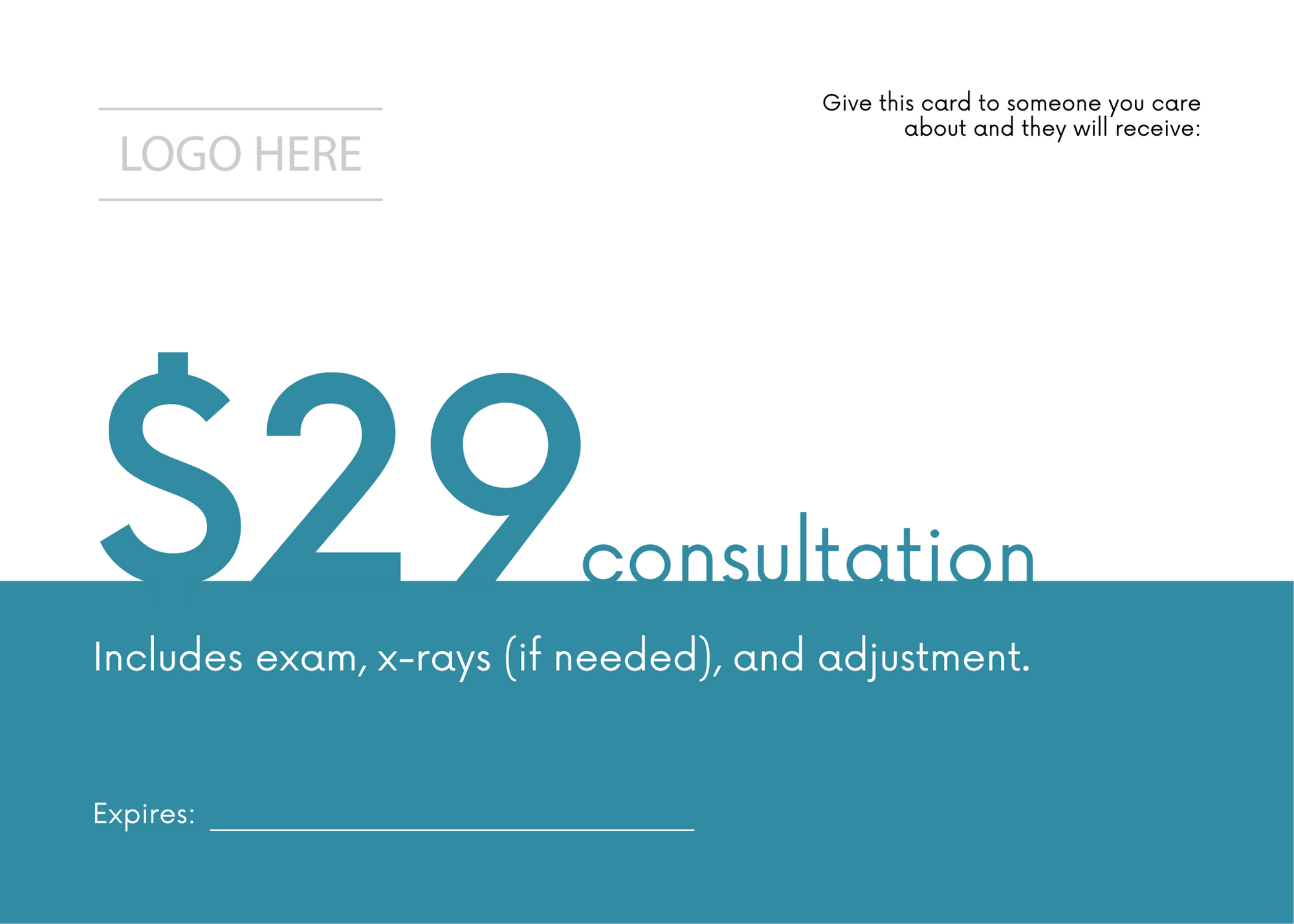
Using a referral card is a great way to ask for referrals. It’s a physical takeaway that the patient walks out with that can act as a “coupon” with an offer on it that can be redeemed. Your patient will be able to hand someone this card and that new person can bring it in to redeem that new-patient offer.
Also, your patient physically has to do something with that card. After they leave, they’re going to have the card in their hand and will either need to find someone to give it to or make the decision to toss it. This puts them in a position where they have to think about and consider referring someone while they are outside your office.
You can either have this conversation with the patient directly, or your staff can take care of this during the check-in / check-out process.
Hi (PATIENT NAME)… I have a few of these referral cards to give you today. You can give these to anyone you care about who you feel would benefit from care here. It gives them a chance to come in to see if we can help them. I’m just going to write a date on here for you. Whoever you give the cards to just needs to come in before this date.

Patient Referral Email Blasts
You should be collecting your patients’ email addresses and storing them on file. Having their email address lets you do all sorts of email marketing and stay in touch with them even beyond their initial care plans. One powerful campaign is to ask for referrals. Send an email to all your patients and ask if they know anyone in their circle who is dealing with any pain or health issue, and say that you’d love to see if you can help them.
There are all sorts of email marketing platforms out there. Simply sign up for one, upload your patient list, and create a simple campaign blast that asks for referrals. You can even set the campaign to repeat itself every few months so it sends automatically as a recurring reminder. (For more on staying in front of your list, see our guide to nurturing patients with email marketing.)
Digital Patient Referral Forms
Another great way to ask for referrals is to have a form on your website that patients can fill out. It lets you collect the referral’s information right away and reach out to start a dialogue. Being proactive is going to yield much better results than being passive and waiting for referrals to contact you. Life happens, and it slows down the process.
The best part about this method is it can be completely automated.
You can use marketing software to text your patients after their appointments automatically, giving them the link to your online referral form. Once a patient fills it out with a referral’s information, you can automatically contact the referral and send them information, all without you lifting a finger. This is exactly the kind of workflow our ENGAGE CRM is built to run, and it pairs perfectly with the same website lead-capture forms that turn your site into a new-patient engine.

2. Incentivize Chiropractic Patient Referrals
If you’re looking to ramp up the number of referrals, you can try incentivizing your patients to participate. There are lots of different ways to provide an incentive that does not break the bank but still gets patients excited and thinking about referral opportunities.
- Gift cards: Give out an Amazon gift card or a local restaurant gift card for each referred patient who signs up for care.
- Raffles / giveaways: Do a drawing to give away a prize like an Apple TV, a smart speaker, or something else that’s fun for patients.
- Free adjustments: Reward your patients with free care options when they refer in a new patient.
- Dual-sided rewards: Reward both the referrer and the new patient (for example, a thank-you gift for your patient plus a new-patient special for their friend). Two-sided offers convert noticeably better because nobody feels awkward about it.
Communicate this incentive with your patients in multiple ways: in the office with signs and banners, in their inbox with emails, and via text message after their appointments. Patients won’t participate if they don’t know about your incentives, so make sure they know!
Important: incentives are where referral programs get into legal trouble. Healthcare has stricter rules than most industries. See Are referral incentives legal? below before you launch anything.
3. Plant The Seed Early
When a patient comes in for their first appointment, start planting the seed for referrals right away. Let them know that your goal as a provider is to help make them feel so good and healthy that they’ll want to refer their friends and family members in. Assure them that you’re there to help them feel better than ever.
Use your education to explain that everyone can benefit from chiropractic care because it has a huge impact on so many areas of the body. This type of language will help spark thoughts about the impact of chiropractic care, enough that they could be having these conversations with their circle of influence outside your office without you even having to ask.
These conversations will pave the way for when you ask for a referral further along in your relationship with them.
4. Acknowledge & Thank Referrers

If you receive a referral, make sure to thank whoever made it. Picking up the phone to thank them, or handwriting a thank-you card, goes a long way in showing your appreciation, and strongly encourages that behavior the next time an opportunity to refer comes up.
That positive reinforcement is likely to drive in even more referrals from the same patient.
This is also a small thing that helps you stand out and further builds the patient relationship. When’s the last time you received a personal call or a handwritten note from your Doctor?
Actions like this form a stronger bond and deeper loyalty to you and your practice. And here’s the bonus: a patient who just got a personal thank-you is the perfect person to also ask for an online review, the digital version of the same word-of-mouth (more on that next).
5. Be a Great Doctor
You can do all the tactics and methods perfectly, but all that activity has to be backed up with excellent care and treatment. Be personable, build relationships, spend the extra time with your patients, and be an amazing Doctor. Going the extra mile to make patients feel important, and that their problems matter, is the foundation of a successful practice where patients keep coming back and referrals happen naturally.
Show patients that you actually care and go above and beyond to make them the center of the universe while they’re in your office. Providing excellent care goes a long way in the long-term success of your practice and the volume of referrals you receive.
A great experience also fuels your online reputation, which is just word-of-mouth at scale. The same patient who’d tell a friend about you will, if you ask, leave a five-star Google review that influences hundreds of strangers searching for a chiropractor. So treat reviews as part of your referral strategy: deliver care worth talking about, then make it easy to share. Our guides on getting more patient reviews and managing your reputation show you how to turn happy patients into public social proof.
6. Build a Professional Referral Network
Patients aren’t your only source of referrals. Other providers can send you a steady stream of pre-qualified patients, often with bigger case value. Building a professional referral network is slower than handing out cards, but those referrals are some of the most loyal you’ll ever get.
Who to build relationships with:
- Primary care physicians (PCPs) who’d rather refer out musculoskeletal complaints than manage them.
- Physical therapists and massage therapists, whose work complements adjustments.
- Personal-injury and auto-accident attorneys, who regularly need a chiropractor for documentation and care after a crash.
- Podiatrists, dentists, personal trainers, and OB/GYNs (prenatal care) whose patients overlap with yours.
How to actually earn those referrals:
- Make the first move. Introduce yourself, explain exactly which cases you’re a great fit for, and make it effortless to send a patient your way.
- Close the loop like a specialist. When another provider refers a patient, send a brief report of findings or case note back, in their clinical language, so they know exactly what you did and why. Nothing builds a two-way referral relationship faster than a chiropractor who communicates like part of the care team.
- Refer out, too. The fastest way to receive referrals is to give them. Be the chiropractor who sends patients to the right PT or specialist when that’s what they need.
A handful of strong provider relationships can outproduce a whole stack of referral cards, and they compound year over year.
Referrals in the Age of AI Search
Word-of-mouth now has a digital twin you can’t ignore. When someone asks Google’s AI Overview or ChatGPT to “recommend a good chiropractor near me,” the practices that get named are the ones with a verified Google Business Profile, consistent information everywhere, and a wall of recent five-star reviews, the same reputation your referral program is already building. Every happy patient you turn into a referrer (and a reviewer) also makes you more likely to be the practice an AI recommends. If you want to get intentional about showing up in those AI answers, read our companion guide on SEO vs AEO for chiropractors. It’s the search-side of the same word-of-mouth engine.
Track & Automate Your Referral Program
A referral program you don’t measure is just a hope. If you can’t answer “how many new patients came from referrals last month, and who sent them?” you can’t improve it, and you can’t thank the right people.
At minimum, track:
- Referral source on every new patient. Add a simple “How did you hear about us?” field at intake and actually log the answer.
- Your referral rate. What share of new patients each month come from referrals? Watch the trend, not just the number.
- Who your top referrers are, so you can thank and nurture them.
The practices that win at referrals make the whole loop automatic. With a CRM like ENGAGE, you can text every patient a referral link a few days after a great appointment, capture the referral on a simple form, instantly follow up with the new lead, and tag the source, all without your front desk lifting a finger. Pair it with automated email and text campaigns and your referral “asks” go out consistently instead of whenever someone remembers.
That’s the difference between referrals as a happy accident and referrals as a predictable channel you can grow on purpose. It’s the same systems-driven approach behind the practices in our case studies.
Are Chiropractic Referral Incentives Legal?
Before you hand out a single gift card, understand this: rewarding referrals is regulated in healthcare, and the rules are stricter than in most industries. A reward that’s perfectly normal for a restaurant can cross a legal line for a doctor’s office. Here’s the background you should know, this is general information, not legal advice:
- The federal Anti-Kickback Statute (AKS). It prohibits knowingly paying “remuneration” to induce or reward referrals for services covered by federal programs like Medicare or Medicaid. Because Medicare covers chiropractic spinal manipulation, chiropractors are not automatically exempt. Violations carry steep fines and even prison. The Department of Justice has prosecuted chiropractors for paying for referrals.
- Beneficiary inducement rules. Giving things of value to Medicare or Medicaid patients to steer their choice of provider can trigger separate civil penalties, so rewarding the new patient can be as much of an issue as rewarding the referrer.
- State law and your chiropractic board. Many states go further than federal law. California’s Business & Professions Code §650, for example, broadly bars paying for patient referrals regardless of who pays for the care, cash patients included. Your state statutes and chiropractic board rules are the ones most likely to apply to a cash-pay practice.
None of this means you can’t run a referral program. The overwhelming majority of practices do. It means you should keep it clean:
- Favor thank-you gestures and recognition over per-head cash bounties.
- Keep any reward modest and not tied to federally-covered services.
- Remember that cash and general-purpose gift cards (Visa/Mastercard, Venmo, and the like) are never treated as small “nominal” gifts. They’re the riskiest reward of all, so lean toward non-cash thank-yous.
- Reward the act of spreading the word, not a guaranteed payment per booked patient.
- When in doubt, ask a healthcare attorney and check your state board before you launch.
The safest referral engine isn’t the one with the biggest prize. It’s the one built on a genuinely great patient experience, where people refer because they want to, not because they’re paid to.
Not legal advice. Referral-incentive laws vary by state and change over time. Confirm your program with a qualified healthcare attorney and your state chiropractic board before offering any reward.
Referrals reward practices that are intentional. Ask every patient, make it easy and compliant to participate, plant the seed early, thank the people who send you business, and back it all with care worth talking about, then let a system do the remembering. Do that consistently and your existing patients become your most productive, and most affordable, marketing channel. Stay consistent, execute, and watch your patient referral numbers grow.
Chiropractic Patient Referrals FAQs
How do I ask patients for referrals without sounding desperate or pushy? Frame the ask around helping people rather than growing your business. Phrases like “if you know anyone who’s struggling with pain or health issues, I’d love to see if I can help them” position you as a caring provider, not a salesperson. You can also use referral cards as a physical prompt: patients walk out with something in hand that naturally gets them thinking about who in their circle could benefit.
What incentives can chiropractors offer to encourage patient referrals? Effective incentives include Amazon or local restaurant gift cards for each referred patient who starts care, monthly prize drawings (like an Apple TV or smart home device), or complimentary adjustments. Communicate the incentive through in-office signage, email blasts to your patient list, and automated post-appointment texts so patients actually know the program exists. Always confirm any reward is legal in your state before offering it.
When should a chiropractor first bring up patient referrals? Start planting the seed at the very first appointment. Let new patients know that your goal is to make them feel so good they’ll want to share that with the people they care about. This early framing normalizes the conversation so that when you ask for a referral later in their care plan, it doesn’t come as a surprise or feel transactional.
How should a chiropractor thank patients who send referrals? A personal thank-you (either a phone call or a handwritten card) goes a long way and stands out in an era of automated messages. That personal acknowledgment reinforces the referring behavior and builds stronger loyalty to your practice. Most patients have never received a personal note from their doctor, so this simple gesture makes a lasting impression.
Are patient referral incentives legal for chiropractors? Sometimes, and it depends heavily on your state. The federal Anti-Kickback Statute restricts rewarding referrals for care covered by Medicare or Medicaid, and some states (like California under Business & Professions Code §650) bar paying for patient referrals even for cash patients. Many practices stay safe by keeping rewards modest, favoring thank-you gestures over per-patient cash, and avoiding incentives tied to federally-covered services. This isn’t legal advice. Confirm your program with a healthcare attorney and your state chiropractic board before launching.
How do chiropractors get referrals from other doctors? Build a professional referral network. Reach out to primary care physicians, physical therapists, massage therapists, and personal-injury attorneys; tell them exactly which cases you’re a great fit for; and make it effortless to send a patient your way. Keep those referrals coming by closing the loop (send a brief report back on referred patients) and by referring out to other providers yourself. Provider referrals are slower to build but tend to be high-value and loyal.
How do you track chiropractic patient referrals? Capture a referral source on every new patient with a simple “How did you hear about us?” field at intake, then watch your monthly referral rate and identify your top referrers. The easiest way is to automate it with a CRM: text patients a referral link after their visit, collect referrals on a form, follow up with the new lead automatically, and tag the source, so referrals become a measurable channel instead of a guess.
How many referrals should a chiropractic practice expect? There’s no universal number. It depends on your patient volume, how actively you ask, and how good the experience is. The more useful goal is to grow your referral rate over time: track what share of new patients come from referrals each month and work to increase it. A practice that asks consistently, incentivizes compliantly, and delivers care worth talking about can realistically make referrals one of its largest and cheapest new-patient sources.
How do I build a chiropractic referral program? Build it from six repeatable parts: ask patients directly (in person and through automated texts), incentivize participation compliantly, plant the seed at the first visit, thank every referrer personally, deliver excellent care, and add a professional referral network. Then log a referral source on every new patient so it becomes a measurable, growable channel.
Ready to turn your patients into a referral engine? CHIROBASIX builds the websites, CRM, and automated follow-up that make referrals happen on autopilot. Book a free call and we’ll map out a plan for your practice.
Keep reading

Facebook Lead Quality for Chiropractors: Why More Leads Can Mean Fewer Patients
More Facebook leads is not the same as more patients. Here is the 6-step friction ladder for trading lead volume for lead quality, and how to pick the right step for your practice.

AEO & GEO for Chiropractors: How to Get Your Practice Recommended by AI
AEO and GEO are two names for one goal: getting your practice cited and recommended inside AI answers. Here's the practice-focused hub guide, built on your SEO foundation.
GEO vs SEO for Chiropractors: What's the Difference?
SEO gets your practice ranked. GEO gets it cited inside the AI answer. Here's how they differ, where they overlap, and why chiropractors need both in 2026.
Want this kind of strategy built for your practice?
Book a free consultation. We'll audit your current marketing and map out the omnipresence plan for your local market.
Book A Free Consultation