


Your website is the hub of your entire marketing system. Your Google Business Profile, your ads, your social posts, your word-of-mouth referrals — they all funnel people back to one place. If that place is slow, generic, or hard to use, every other dollar you spend works harder for less.

That’s the mindset behind everything in this guide. Below we cover the four things that turn website design for chiropractors from a digital brochure into a steady source of new patients: the design, the SEO, the conversion strategy, and the ongoing care that keeps it all working.
The 3 Jobs of Your Website: Be Found, Educate, Convert
On our Chiropractic Practice Success podcast, we come back to the same simple model again and again: a great chiropractic website has exactly three jobs.
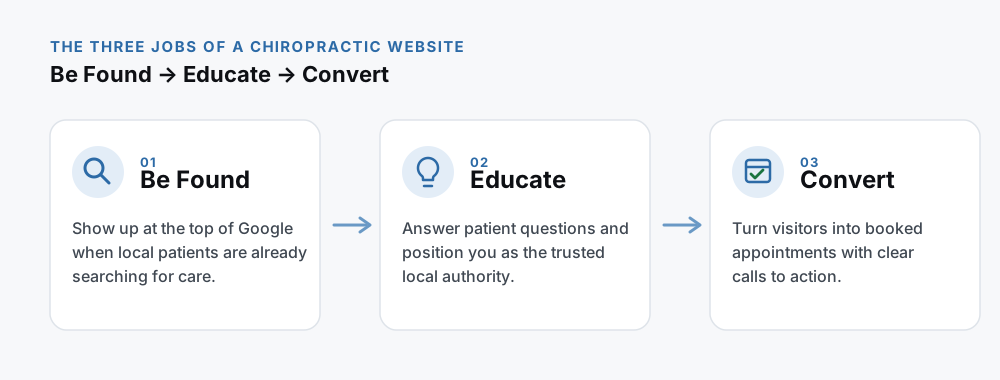
- Be found. If patients can’t find your site when they search, nothing else matters. Job one is showing up on Google — in the map results and the organic listings — when someone in your town searches for the care you provide.
- Educate. A huge share of people don’t fully understand what chiropractic care is or how it can help them. Your website’s job is to answer their questions, ease their concerns, and position you as the trusted local authority — before they ever pick up the phone.
- Convert. Traffic that doesn’t book is just a vanity number. The site has to guide a visitor toward one clear next step: booking an appointment, requesting a time, or calling your office.
Here’s why all three matter so much: patients rarely book on the first visit to your site. Think about how you buy a car. You don’t wake up one morning and drive off the lot that afternoon — you notice a need, research, compare, second-guess, and eventually decide. Choosing a healthcare provider is the same. Your website has to earn a patient’s trust across that whole journey, which is exactly why “be found,” “educate,” and “convert” have to work together. A site that ranks but doesn’t convert leaks patients. A beautiful site nobody can find is a billboard in the desert.
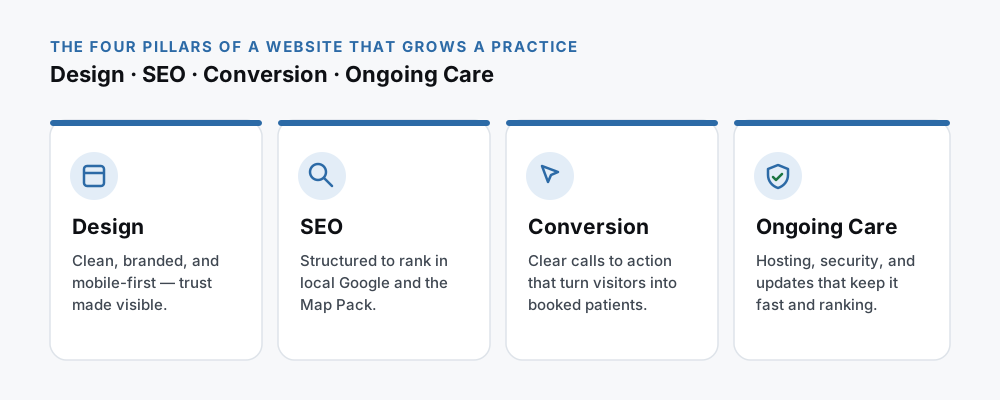
The Four Pillars of a Website That Grows a Practice
Those three jobs are delivered through four practical pillars. The rest of this guide walks through each one.
Pillar 1 — The Design Foundation
Good design isn’t decoration — it’s clarity and trust made visible. And patients decide fast. Research going back two decades found that people form a first impression of a web page’s visual appeal in about 50 milliseconds (Lindgaard et al., 2006) — literally faster than a conscious thought. In healthcare, where trust is everything, that snap judgment carries real weight.

Here’s what a design that earns that first impression looks like:
- Modern, branded, and clean. Dated designs make a poor first impression and quietly signal that the practice itself might be behind the times. Your site should look like your practice — your colors, your personality — not a generic template anyone could be using.
- Mobile-first, not mobile-friendly-as-an-afterthought. More than half of all web traffic now happens on a phone (Statcounter, 2026), and your patients are often searching in discomfort, wanting fast answers. The mobile experience isn’t a secondary concern; it’s the main event. Buttons should be thumb-sized, text readable without zooming, and the most important information up top.
- Real photography. Authentic images of your team, your office, and your community dramatically outperform stock photos. The most valuable shots are action shots — you actually adjusting a patient. As we put it on the podcast: people get a real glimpse of the experience, so “they know it’s safe, they know it’s not invasive, and they can tell people are having a good time because they’re smiling.” A single media day can supply a year’s worth of photos and video for your site and every other channel.
- Visual hierarchy. The eye should be guided naturally from your headline, to the benefit, to the call to action. Good design tells visitors where to look and what to do next without making them think.
- Fast. Compressed images and clean code aren’t just technical niceties — speed is a first-impression factor, a ranking factor, and (as you’ll see in Pillar 3) a conversion factor. Every extra second of load time costs you visitors.
Pillar 2 — The SEO Foundation
A beautiful site nobody finds is a billboard in the desert. Search-friendly structure is non-negotiable if you want patients to discover you organically. It helps to think about SEO in three buckets:
1. Technical structure — how the site is built. Proper page titles, header structure, descriptive URLs, image alt text, schema markup, HTTPS security, and speed, so search engines clearly understand your content. This is the invisible foundation, and it’s often the difference between page one and page five. It’s also the bucket most DIY sites get wrong — if your site was thrown together on a cheap builder, technical problems may be quietly holding it back from ranking no matter how nice the homepage looks.
2. Valuable content — a page for everything patients search. This is the single biggest lever most practices are missing, and it deserves emphasis:
If your website doesn’t have a page dedicated to back pain treatment, you’re not going to rank for it. Somebody else nearby probably does have a back-pain page — and Google is going to rank their page over yours.
— Nick Fischer, on the Chiropractic Practice Success podcast
So build a dedicated page for every service and every major symptom — “Back Pain Relief,” “Sciatica,” “Headaches & Migraines,” “Prenatal Care,” “Auto Accident Injury.” Each page is a focused opportunity to rank for exactly what patients type into Google, and a place where those patients immediately see that you treat their specific problem. Good content does double duty: it educates and nurtures the patient and it signals quality to Google. Remember, Google wants to serve the pages with the best answers to what people are searching — so the practice with the most genuinely helpful content tends to win.
3. Off-page signals — proof you’re legitimate. Consistent name, address, and phone number across the web; an embedded map; a well-managed Google Business Profile; local citations; and links from other reputable sites. These tell Google precisely where you are, who you serve, and that you’re the real deal.
For a deeper dive into ranking specifically, see our full SEO for chiropractors guide and our dedicated chiropractor SEO service.
Pillar 3 — The Conversion Foundation
Traffic means nothing if it doesn’t book. Conversion design is what turns visitors into actual patients — and it starts with something invisible: speed. Conversion rates climb sharply the faster a page loads.
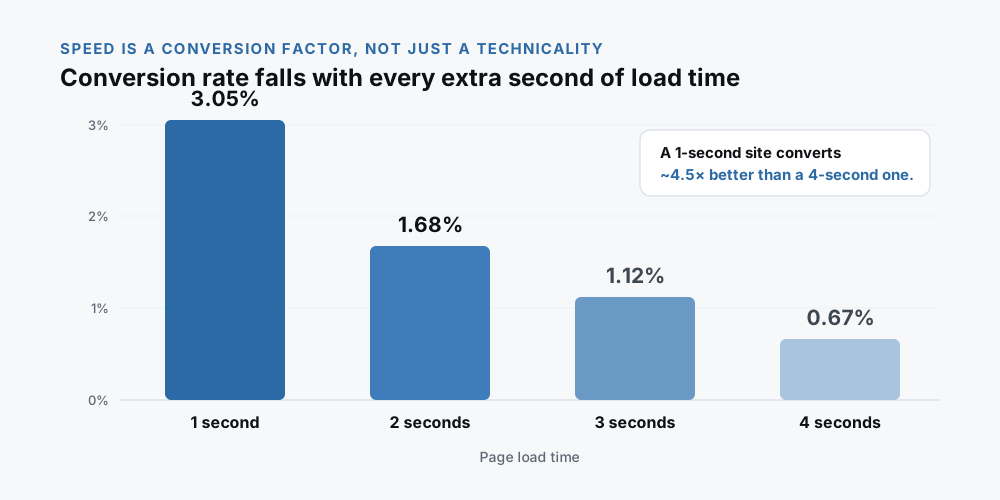
When a page takes longer than three seconds to load, 53% of mobile visitors abandon it (Google) — that’s half your hard-won traffic gone before they see a word. Once the page is fast, the rest of conversion design does its job:
- A clickable phone number in the header, visible on every page and tap-to-call on mobile.
- Big, high-contrast “Book Appointment” calls to action, repeated throughout. Your CTAs should pop off the page and draw the eye, so a visitor always knows exactly where to click next. Never make someone scroll back to find how to take the next step.
- Simple lead forms and online scheduling that integrate with your booking software or EHR, so a patient can request or book a time in seconds without phone tag.
- A website chat widget. It sounds small, but a little chat box in the corner reliably lifts lead volume — you’d be surprised how many people will start a chat who would never have filled out a contact form.
- Trust elements at decision points. Reviews, testimonials, before-and-after stories, insurance information, and clear new-patient offers placed exactly where a hesitant visitor needs reassurance. This matters more than most practices realize: 97% of consumers read online reviews for local businesses (BrightLocal, 2026).
- A compelling new-patient offer. A clear, low-friction first step — a consultation, an exam special, a free assessment — gives fence-sitters a reason to act now rather than “think about it” and forget.
Want to squeeze more bookings out of the traffic you already have? Our post on getting more patient leads from your website breaks down the highest-impact tweaks.
Pillar 4 — Content & Ongoing Care
The best chiropractic websites aren’t static — they grow, and they’re cared for.
Content compounds. Publishing helpful, educational content does three things at once: it builds the topical authority that lifts your whole site in Google’s eyes, it targets the long-tail questions patients search (“is chiropractic safe during pregnancy?”), and it gives prospective patients material that builds trust before they ever call. A steady cadence of articles, FAQ pages, and updated service pages signals to Google that your site is active and authoritative — and gives you something fresh to share on social and email. Think of every quality page as compounding interest that keeps working for years. A smart shortcut: create one substantial “pillar” piece, then slice it into smaller posts, videos, and social clips.
Care keeps it alive. A website is a living asset, not a one-time project. To stay fast, safe, and high-ranking it needs:
- Reliable, fast hosting with strong uptime so your site is always available when a patient is ready to book.
- Security — an SSL certificate, regular updates, and active monitoring to protect both your site and your patients’ contact information.
- Regular updates and backups so the site stays current, fast, and recoverable if anything goes wrong.
- Performance monitoring to catch slowdowns before they cost you rankings or bookings.
Letting these slip is exactly how a fast, beautiful new site slowly decays into a slow, vulnerable, outdated one within a couple of years.
Measuring What Matters
You can’t improve what you don’t measure. A few metrics tell you whether your website is actually doing its three jobs:
- Organic traffic and keyword rankings — are more people finding you on Google over time? (Job 1.)
- Time on page and pages per visit — are visitors engaging with your content, or leaving immediately? (Job 2.)
- Conversion rate, new-patient calls, and form submissions — what share of visitors actually book? (Job 3.)
- Mobile vs. desktop performance — since most traffic is mobile, that experience matters most.
Reviewing these regularly turns your website from a “set it and forget it” expense into a managed, improving asset.
Getting It Done
You can assemble all of this yourself — design, SEO, conversion, content, hosting, and measurement — or you can have it handled. Our chiropractic website design program covers every pillar in this guide for a simple monthly fee, so you get a site engineered to rank and convert without the heavy lifting or the steep learning curve. Book a free consultation and we’ll map out exactly what your practice needs to turn your website into your hardest-working employee.
Keep reading
AEO & GEO for Chiropractors: How to Get Your Practice Recommended by AI
AEO and GEO are two names for one goal — getting your practice cited and recommended inside AI answers. Here's the practice-focused hub guide, built on your SEO foundation.
GEO vs SEO for Chiropractors: What's the Difference?
SEO gets your practice ranked. GEO gets it cited inside the AI answer. Here's how they differ, where they overlap, and why chiropractors need both in 2026.

How to Get Your Chiropractic Practice Cited by ChatGPT & AI Search
AEO and GEO are two names for one job: getting your practice cited inside AI-generated answers. Here's the practical how-to for chiropractors — the six signals that earn AI citations, step by step.
Want this kind of strategy built for your practice?
Book a free consultation. We'll audit your current marketing and map out the omnipresence plan for your local market.
Book A Free Consultation