
Chiropractic Google Ads Benchmarks 2027: Cost per Click, Cost per Conversion and Monthly Spend
Chiropractic Google Ads benchmarks for 2027: cost per click, cost per conversion, monthly spend and the month-by-month trend, from real practice ad accounts.
In the chiropractic Google Ads accounts we benchmarked (Nov 2025 to Oct 2026), the median practice spent $1,025 a month, paid $5.23 per click and $23.55 per conversion, with a 4.42% click-through rate. Clicks got about a third more expensive during the year, but cost per conversion held roughly steady.

Every chiropractor who runs Google Ads eventually asks the same question: is my account normal? Your agency says the cost per click is fine. Your colleague says hers is half that. Google’s own suggestions always say spend more. Without a benchmark from practices like yours, there’s no way to tell a healthy account from one that’s leaking money.
So here’s ours. These chiropractic Google Ads benchmarks come from the Google Search accounts we manage for US chiropractic practices, twelve full months from November 2025 to October 2026: cost per click, cost per conversion, monthly spend, click-through and conversion rates, how they moved month by month, and the ranges that should make you look harder at your own numbers. It’s a deeper cut of the paid ads section of our State of Chiropractic Marketing 2027 report, with new breakdowns that weren’t in the report.
TL;DR:
- The median practice paid $5.23 per click and $23.55 per conversion, and spent $1,025 a month (Nov 2025 to Oct 2026).
- Clicks got pricier: among practices that advertised every month, the median cost per click went from $4.24 to $5.61 (+32%), with the step up in June 2026.
- Conversions didn’t: in those same practices, the median cost per conversion fell 7% from the first half of the year to the second, because conversion rates rose.
- There was no January surge. January had the cheapest clicks of the year.
- Branded search clicks cost a median $2.18 vs $5.62 for non-brand clicks in the same accounts.
- Spending more didn’t buy cheaper conversions. The top third of spenders paid about double per conversion.
Every figure is a median across many practices; none rests on fewer than 5.
Chiropractic Google Ads Cost at a Glance
Here’s the full distribution. The median is the middle practice. The 25th to 75th percentile range (the middle half of practices) is what “normal” looks like. The 10th and 90th percentiles show where the outliers start.
| Metric (per practice, Nov 2025 to Oct 2026) | 10th pct | 25th pct | Median | 75th pct | 90th pct |
|---|---|---|---|---|---|
| Monthly spend | $751 | $883 | $1,025 | $1,149 | $2,065 |
| Cost per click | $3.10 | $3.38 | $5.23 | $5.99 | $7.28 |
| Click-through rate | 2.91% | 3.66% | 4.42% | 5.57% | 6.77% |
| Conversion rate (conversions per click) | 9.0% | 14.7% | 22.4% | 35.9% | 48.4% |
| Cost per conversion | $8.34 | $13.49 | $23.55 | $34.51 | $65.34 |
| Clicks per month | 126 | 170 | 237 | 309 | 418 |
| Conversions per month | 21 | 39 | 54 | 82 | 118 |
Two more numbers from the report: search ads drove a median of 35 phone calls a month per practice (middle half 22 to 52), at a median $31.14 per call ($23.33 to $46.04). Calls overlap with conversions in most accounts, so don’t add the two together.
A note on that conversion rate. A 22% conversion rate doesn’t mean one in five clickers became a patient. Most accounts count calls and booking requests as conversions, so this is “clicked and then called or asked to book,” not “started care.” More on that in how to use these benchmarks.
Cost per Click: $5.23, and Rising
The median chiropractic cost per click was $5.23 over the year, and the middle half of practices paid $3.38 to $5.99. Pooled across every click, it was $4.81.
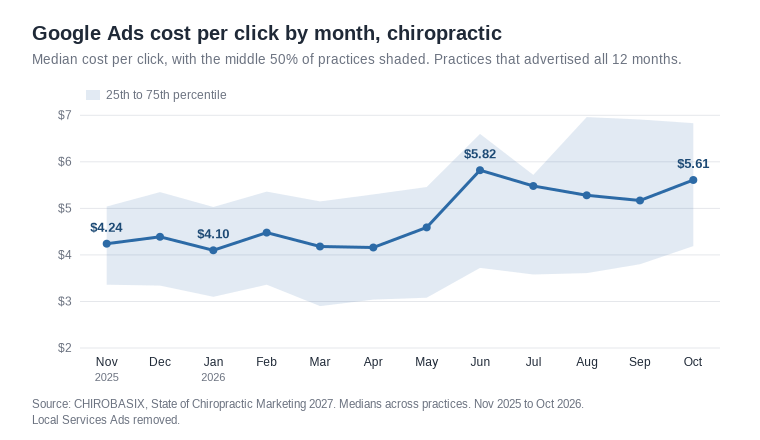
The more useful story is the direction. Because new accounts joined during the year, we tracked trend lines on the practices that advertised in all twelve months, so the comparison is the same practices month after month.
What happened:
- November to May was flat. The median sat between $4.10 and $4.59 a click.
- June was a step, not a slope. The median jumped to $5.82 and never went back. By October it was $5.61, 32% higher than November ($4.24). Pooled across all clicks the rise was 45% ($3.91 to $5.67).
- It hit almost everyone. Comparing each practice’s second half of the year (May to October) with its first half, 85% paid more per click, and the median practice paid 19.5% more.
We can’t tell you from this data why June moved. More advertisers bidding on the same local searches, Google’s auction changes and seasonal competition can all push prices up, and an account-level dataset can’t separate them. What we can tell you is that if your cost per click rose in mid-2026, you weren’t alone, and it wasn’t necessarily your campaign.
Cost per Conversion: Steady While Clicks Got Pricier
This is the finding that surprised us most, and it’s not in the report.
If clicks cost a third more, you’d expect each lead to cost a third more too. It didn’t happen. The median chiropractic cost per conversion was $23.55 for the year (middle half $13.49 to $34.51), and in the practices that advertised every month it stayed roughly level from quarter to quarter.
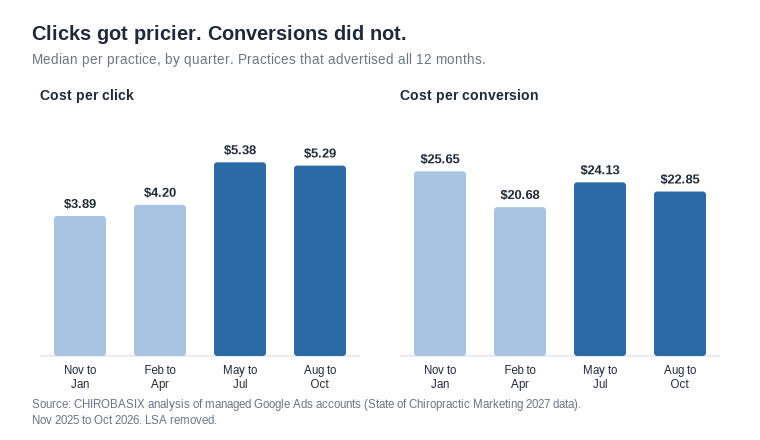
| Quarter | Median cost per click | Median cost per conversion | Median conversion rate |
|---|---|---|---|
| Nov 2025 to Jan 2026 | $3.89 | $25.65 | 18.2% |
| Feb to Apr 2026 | $4.20 | $20.68 | 20.0% |
| May to Jul 2026 | $5.38 | $24.13 | 23.2% |
| Aug to Oct 2026 | $5.29 | $22.85 | 24.4% |
The reason is the last column. Conversion rates climbed from 18.2% to 24.4% over the year, which offset the pricier clicks. Practice by practice, the second half of the year cost a median 7% less per conversion than the first half, even though clicks cost 19.5% more.
One honest caveat: conversion rate depends on what each account counts as a conversion. If an account starts counting website calls or online bookings partway through the year, its conversion rate jumps even though nothing changed for patients. Some of this improvement may be better tracking rather than better results. Either way, the lesson for your own account holds: don’t judge Google Ads by cost per click. A rising CPC with a steady cost per booked patient is a healthy account. A flat CPC with a rising cost per patient is not.
(The quarterly cost per click here is each practice’s total spend divided by its total clicks for the quarter, which weights busy months more heavily than the monthly medians above. Both are correct; they answer slightly different questions.)
Monthly Spend: About $1,000 a Month
The median practice spent $1,025 a month on Google Search ads (middle half $883 to $1,149). That narrow range is no accident: these are accounts we manage, and the ad budget we recommend on our pricing page is $1,000 to $1,500 a month, paid directly to Google. A random sample of all chiropractors would show a wider spread. The 10th and 90th percentiles ($751 and $2,065) show the practices running leaner or pushing harder.
What did more budget buy? We split practices into thirds by monthly spend:
| Spend group | Median monthly spend | Median cost per conversion (middle half) |
|---|---|---|
| Lowest third (under $945 a month) | $806 | $13.96 ($8.25 to $22.60) |
| Middle third ($945 to $1,066) | $1,014 | $23.55 ($16.55 to $48.46) |
| Highest third ($1,069 a month and up) | $1,550 | $29.37 ($23.77 to $40.32) |
The top third paid about double per conversion. Cost per click barely moved with budget ($4.74, $5.48 and $5.29 across the three groups), and cost per phone call didn’t rise either ($33.70, $32.70 and $28.44). That’s the pattern you’d expect from diminishing returns: the first dollars buy the cheapest, highest-intent searches in your area, and every extra dollar reaches a little further out. This is a correlation, not proof that budget causes higher costs (bigger markets may need bigger budgets and cost more), but it’s a good reason to raise a budget in steps and watch cost per patient, rather than doubling it and hoping.
Month by Month: Is There a Chiropractic Google Ads Season?
Here’s every month for the practices that advertised all year. Median spend, CPC, click-through rate and cost per conversion, plus conversion rate, which wasn’t in the report.
| Month | Median spend | Median CPC | Median CTR | Median conversion rate | Median cost per conversion |
|---|---|---|---|---|---|
| Nov 2025 | $931 | $4.24 | 4.89% | 17.6% | $27.59 |
| Dec 2025 | $1,160 | $4.39 | 5.22% | 15.8% | $27.97 |
| Jan 2026 | $1,047 | $4.10 | 5.50% | 19.7% | $22.19 |
| Feb 2026 | $994 | $4.48 | 5.64% | 17.4% | $25.86 |
| Mar 2026 | $1,102 | $4.18 | 5.52% | 18.6% | $24.12 |
| Apr 2026 | $1,099 | $4.16 | 5.28% | 22.9% | $17.74 |
| May 2026 | $993 | $4.59 | 4.94% | 25.8% | $18.59 |
| Jun 2026 | $1,580 | $5.82 | 4.69% | 22.3% | $27.85 |
| Jul 2026 | $1,131 | $5.48 | 5.47% | 22.8% | $24.12 |
| Aug 2026 | $987 | $5.28 | 4.92% | 25.2% | $21.79 |
| Sep 2026 | $932 | $5.17 | 5.02% | 23.2% | $21.58 |
| Oct 2026 | $987 | $5.61 | 5.08% | 18.9% | $32.98 |
What stands out:
- January was cheap, not expensive. January 2026 had the lowest median CPC of the year ($4.10) and a lower cost per conversion ($22.19) than November or December. If you’ve been told to pull back in January because “everyone advertises after New Year,” this data says the opposite.
- April and May were the most efficient months. Median cost per conversion bottomed out at $17.74 in April and $18.59 in May, the only two months under $20.
- June was the most expensive month to buy clicks. It was also the biggest spending month, and click-through rate dipped to its low for the year (4.69%).
- October’s cost per conversion ($32.98) is the high for the year. We’d read that cautiously: conversions keep arriving for days after a click, and the most recent month in any dataset is the one most likely to be undercounted.
The practical read: there’s no month where chiropractic Google Ads stop working. If you want to push harder at one point in the year, late winter and spring were the best value in this data.
Campaign Types: Branded vs Non-Brand
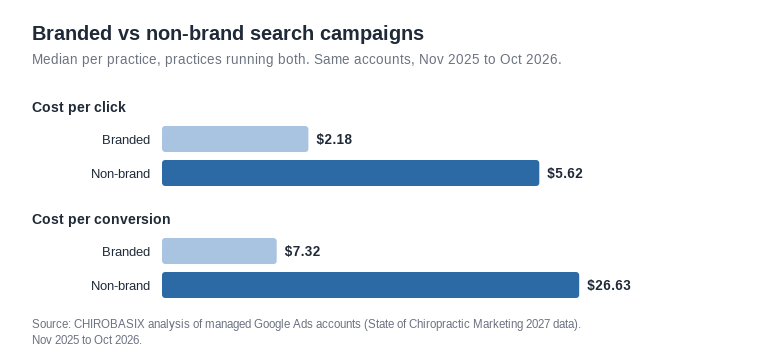
Most chiropractic Google Ads accounts we manage have two kinds of search campaigns: non-brand (people searching “chiropractor near me” or a condition) and branded (people searching your practice or doctor name). They behave very differently, so they should never be judged together.
| Median per practice (middle half) | Branded campaigns | Non-brand campaigns |
|---|---|---|
| Cost per click | $2.18 ($1.38 to $2.58) | $5.62 ($4.44 to $6.42) |
| Conversion rate | 30.0% (20.6% to 39.6%) | 22.2% (17.4% to 34.6%) |
| Cost per conversion | $7.32 ($3.43 to $11.01) | $26.63 ($14.76 to $33.26) |
Branded campaigns took a median 5.5% of a practice’s search spend but produced a median 17% of its conversions. That looks like a bargain, and it’s cheap insurance against a competitor bidding on your name. But those searchers already knew who you were, and many would have found you without the ad. So:
- Report branded and non-brand results separately. A blended cost per conversion that includes branded search will always look better than the new-patient engine underneath it.
- Judge growth on non-brand. The non-brand cost per conversion ($26.63 median) is the honest number for “what does it cost to reach someone who didn’t know us yet.”
What about Performance Max and Local Services Ads? We don’t start practices on Performance Max (our Google Ads guide explains why), so there’s no Performance Max benchmark here. And too few practices ran Local Services Ads across the year to report a figure without identifying anyone, so we removed LSA from every number in this post. We also checked whether we could split costs by keyword theme (auto injury, condition searches and so on). The vast majority of non-brand spend sat in general chiropractic campaigns, so a theme split would rest on too few practices to publish.
Day of Week
Should you turn ads off on certain days? We looked at each practice’s results by weekday and compared them with that practice’s own average, so a high-cost market doesn’t skew the picture.
| Day | Median CPC | Median cost per conversion | vs the practice’s own average cost per conversion | Share of spend | Share of conversions |
|---|---|---|---|---|---|
| Monday | $5.14 | $21.82 | 3% lower | 24.0% | 25.3% |
| Tuesday | $5.18 | $25.42 | 3% higher | 19.0% | 17.6% |
| Wednesday | $5.08 | $22.05 | 5% lower | 20.1% | 21.5% |
| Thursday | $5.01 | $23.41 | 2% lower | 19.3% | 20.2% |
| Friday | $4.95 | $27.42 | 13% higher | 15.8% | 14.0% |
Monday is the busiest day: the biggest share of spend and an even bigger share of conversions. Tuesday through Thursday sit within a few percent of average. Friday is the weak day, with conversions costing a median 13% more than each practice’s own average, Our guess: fewer people want to book a first visit heading into a weekend. Weekends took under 2% of spend in these accounts, too little to benchmark.
The takeaway isn’t “turn off Fridays.” A 13% premium on one day is small next to the cost of missing a call. It’s “make sure Monday is fully funded,” because a daily budget that runs out by Monday afternoon is the most expensive mistake on this list.
How to Use These Benchmarks: What’s Good, What’s a Red Flag
Pull the last 90 days from your Google Ads account (Search campaigns only, Local Services Ads excluded, branded and non-brand separated if you can) and compare:
| Metric | Healthy (middle half) | Worth a look | Red flag (outside 90% of practices) |
|---|---|---|---|
| Cost per click | $3.38 to $5.99 | Above $6 | Above about $7.30, or a sudden jump with no change in results |
| Click-through rate | 3.66% to 5.57% | Under 3.66% | Under about 2.9% |
| Conversion rate | 14.7% to 35.9% | Under 14.7% | Under 9%, or over 50% (check what’s being counted) |
| Cost per conversion | $13.49 to $34.51 | Above $34.51 | Above about $65 |
| Cost per call from ads | $23.33 to $46.04 | Above $46 | No call tracking at all |
How to read your results:
- A high cost per click alone isn’t a problem. If cost per conversion and cost per new patient are in range, a high CPC just means a competitive market.
- A low click-through rate is usually a keyword problem. Under about 3% often means ads are showing for searches that aren’t patients (jobs, schools, DIY). The fix is a real negative keyword list and tighter keywords. Our keyword list for chiropractors is a starting point.
- A very high conversion rate is a tracking problem, not a win. Over 50% almost always means the account is counting things that aren’t leads: page views, button clicks, a booking that fires twice. Fix it before you trust any other number.
- Cost per conversion is the number to manage, but not the last number. A conversion is a call or form. What you actually care about is cost per new patient who shows up. Track calls through to booked visits, ideally in your CRM. If you’re choosing tools for that, see our roundup of chiropractic software.
- Compare like with like. If you run Google and Facebook, don’t compare Google cost per conversion directly with Meta cost per lead. Most Google conversions are people who searched and then called; most Meta leads are instant-form submissions. Our chiropractic advertising guide covers how the channels fit together.
If you want a rough read on what your budget should produce, our marketing ROI calculator does the math with your own numbers.
How We Got These Numbers
Every figure is a median across many practices; none rests on fewer than 5.
- Source: the Google Ads accounts CHIROBASIX manages for US chiropractic practices, synced daily into our reporting system. These are the same accounts and rules as the State of Chiropractic Marketing 2027 report.
- Window: 12 full months, November 1, 2025 to October 31, 2026.
- Who’s included: practices with at least 3 months of Google Search spend in the window. Non-chiropractic and non-US accounts were excluded. Trend figures use only practices that advertised in all 12 months, so new accounts joining don’t distort the trend.
- How it’s calculated: each practice’s metric is computed over its own active months (for example, total spend divided by total clicks), then we take the median across practices.
- Local Services Ads removed from every figure, because LSA bills per lead, not per click.
- Conversions are Google Ads’ primary conversion actions as each account defines them, usually calls and booking requests. One account with more conversions than clicks was left out of conversion figures.
- Branded vs non-brand is classified by campaign name. Day of week uses daily account totals.
- What this isn’t: a random sample of every chiropractor. These are agency-managed accounts with similar budgets and setups, all current clients. That makes them consistent with each other, and it means a self-managed account may look different.
Cite This Data
Journalists, associations and other writers are welcome to quote any figure with its date window. Suggested citation:
CHIROBASIX, “Chiropractic Google Ads Benchmarks 2027,” chirobasix.com/blog/chiropractic-google-ads-benchmarks/, published November 23, 2026. Data window: November 1, 2025 to October 31, 2026. Source study: CHIROBASIX, The State of Chiropractic Marketing 2027, chirobasix.com/guides/state-of-chiropractic-marketing/.
Questions about the data: hello@chirobasix.com.
Frequently Asked Questions
What is the average cost per click for chiropractic Google Ads?
In the practices we benchmarked, the median chiropractic cost per click was $5.23 from November 2025 to October 2026, and the middle half of practices paid $3.38 to $5.99. Among practices that advertised every month, the median rose from $4.24 to $5.61 during the year.
What is a good cost per conversion for chiropractic Google Ads?
The median practice paid $23.55 per Google Ads conversion, and the middle half paid $13.49 to $34.51. Under about $35 is in the normal range. Conversions are defined per account, so judge your own account by what a booked new patient costs.
How much do chiropractors spend on Google Ads per month?
The median practice in our data spent $1,025 a month on Google Search ads, with the middle half between $883 and $1,149. Spending more did not buy cheaper conversions: practices in the top third of spend paid about double per conversion.
Is January the most expensive month for chiropractic Google Ads?
No. In our data, January 2026 had the lowest median cost per click of the year ($4.10) and a lower cost per conversion ($22.19) than November or December. The jump in click prices came in June 2026, not after New Year.
What is a good click-through rate for chiropractic Google Ads?
The median chiropractic search account had a 4.42% click-through rate, and the middle half ran 3.66% to 5.57%. Below about 3% usually means the ads are showing for searches that don’t match, or the ad copy doesn’t give a reason to click.
Do branded Google Ads campaigns cost less for chiropractors?
Yes. In practices running both, branded search clicks cost a median $2.18 versus $5.62 for non-brand clicks, and a branded conversion cost $7.32 versus $26.63. Report branded results separately, because those searchers already knew your name.
Want to Know How Your Account Compares?
Benchmarks tell you whether something’s off. They don’t tell you what to fix. If your numbers land in the “worth a look” or “red flag” columns, or you simply don’t know what your cost per new patient is, book a call and we’ll walk through your account with you. If you’d rather hand it off, here’s how we run Google Ads for chiropractors.
Data window November 2025 to October 2026. Published November 23, 2026.
Keep reading

Chiropractic Logo and Branding: How to Build a Brand Patients Remember
How to build a chiropractic brand patients remember: logo types, the clichés to avoid, colors, fonts, naming, trademark basics, a brand kit checklist and how to choose a designer.

Chiropractic Review Request Templates: 30+ Texts, Emails and Scripts
A copy-paste library of chiropractic review request templates: in-office scripts, texts, reminders, emails, QR card copy, Spanish versions, and a what-not-to-say table.

How to Grow a Chiropractic Practice: 29 Proven Ideas (2026)
Growing a chiropractic practice takes more than marketing. Here are 29 ideas across every growth lever, from the phone and the report of findings to retention, team, KPIs and a second location.
Want this kind of strategy built for your practice?
Book a free consultation. We'll audit your current marketing and map out the omnipresence plan for your local market.
Book A Free Consultation