
Back in 2020 we did some very serious research. By research, I mean we watched The Office start to finish (again) and wrote up three marketing strategies that could have saved Dunder Mifflin: a real website, targeted ads and email marketing. The paper company did not take our advice. It did not know we existed.
So we’re trying again, with a client who needs us more.
The Situation in Scranton
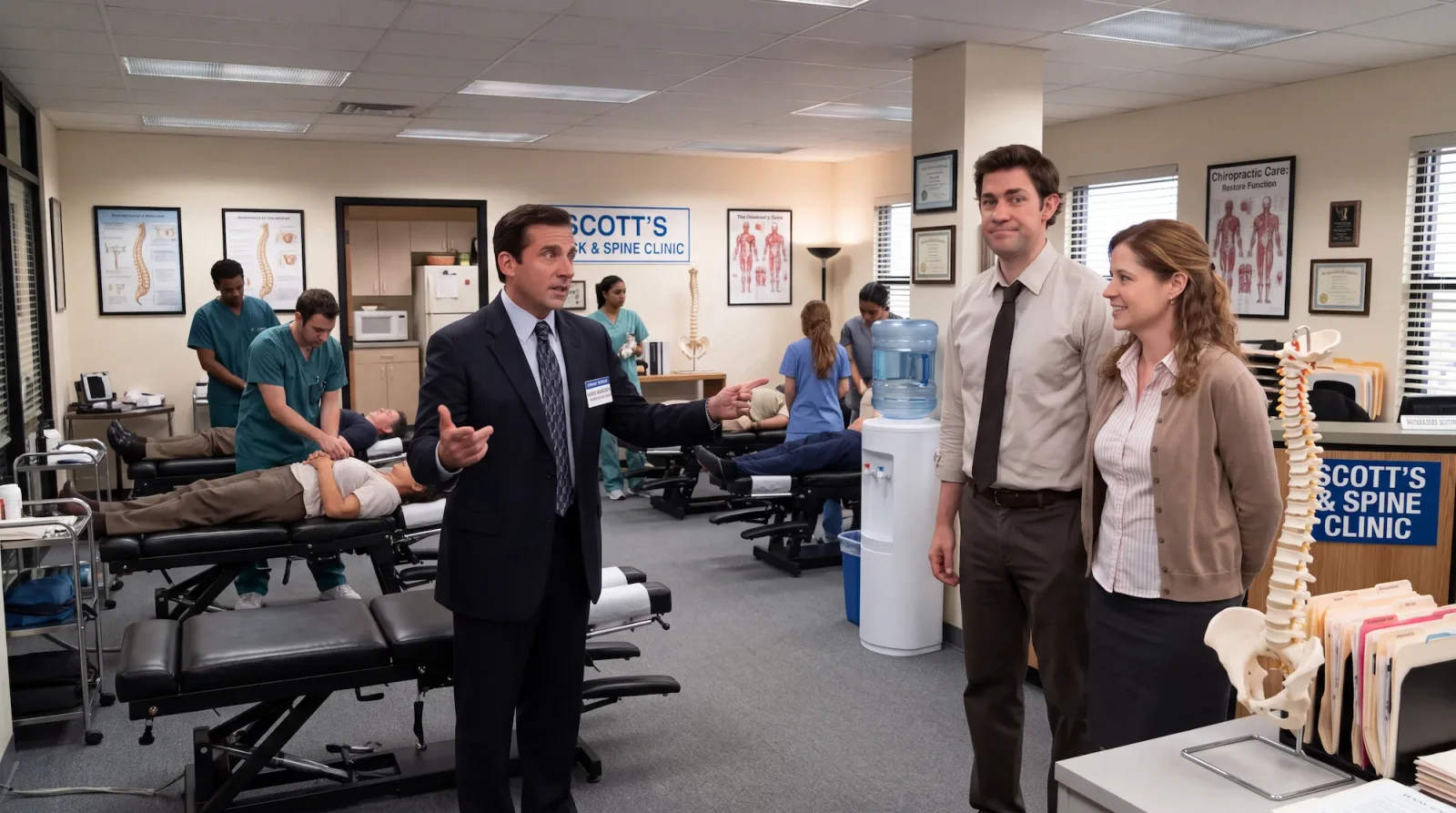
Picture it. Michael Scott has left paper behind and opened a chiropractic practice in a Scranton business park. He still has the World’s Best Boss mug. He has upgraded it to a second mug that says World’s Best Chiropractic Office Owner, which he also bought for himself.
Patients love him. He remembers their kids’ names, their dogs’ birthdays and their fantasy football standings. People leave the office smiling.
And the practice is in trouble, because there is no system. None. The schedule lives on a whiteboard. The marketing plan is a framed photo of Michael shaking hands with the mayor. The front desk has never once asked anyone for anything.
The CHIROBASIX team is concerned. We’ve staged a gentle intervention (no Diversity Day, we promise) and brought six strategies to save Michael Scott Chiropractic.
1. A Website, Not a Gadget
Ryan is back, and he has a pitch. He wants to put the whole practice on a custom app. It has a loyalty points wallet, a social feed, a mascot, push notifications, augmented reality posture filters and a feature he calls “the blockchain part” that nobody can get him to explain. It cost more than the adjusting tables. Eleven patients have downloaded it. Nine of them are Michael’s relatives.
Ryan has been selling shiny things since Dunder Mifflin Infinity. The shiny thing has never been the fix.
Here is the unglamorous truth: a new patient in Scranton is not going to download an app to book a first visit at an office they’ve never been to. They are going to search on their phone, land on a website and decide in about ten seconds whether they can book. If they can’t, they leave.
What Michael actually needs is a fast, mobile-first website with the phone number at the top, online booking on every page, real photos of the real office, the doctor’s bio and the new patient offer spelled out clearly. That’s it. That’s the gadget.
Ryan has been asked to sit in the parking lot and think about it. If you’re making the same decision, our chiropractic website design guide covers what a site that books visits looks like, and our website program is what we’d build for Michael.
2. Pam Needs to Ask
Pam is the best thing about this office. She’s warm, she’s calm, she knows everyone, and she sketches little watercolors of the waiting room on her lunch break. Patients adore her.
Pam has never asked a single patient for a Google review.
It isn’t because she doesn’t want to. She just doesn’t want to bother anyone. So every happy patient walks out the door, tells their family how great the visit was, and leaves exactly zero evidence of it anywhere a stranger could find it. Meanwhile the practice across town, which is fine, has 400 reviews.
The fix is a simple, repeatable ask at the right moment (when a patient says something nice, not when they’re paying) plus a text with a direct link so it takes thirty seconds. Pam doesn’t have to be pushy. She has to be consistent. Our guide on how to get more chiropractic patient reviews has the timing and the exact texts.
A word from Angela, compliance. Once the reviews start coming in, Michael wants to reply to every one personally, with details. Angela has intercepted three drafts already. One thanked a patient by name for coming in about a specific complaint. One mentioned how many visits someone had. One was a poem. Angela is right about all three: a reply that confirms someone is a patient, or says anything about why they came in, is a privacy problem, even when the patient mentioned it first. Keep replies warm, short and general. Here’s how to respond to Google reviews the HIPAA-safe way.
3. Turn Charm Into Referrals
Michael’s whole personality is a referral program that nobody switched on.
Every patient loves him. Every patient tells their coworkers about the funny chiropractor who did a full impression routine during their visit. And nobody actually sends anybody in, because nobody has been given a reason, a moment or a way.
Charm is a great raw material. It is not a system. To turn it into one, Michael needs to:
- Plant the seed at the first visit, so patients know he welcomes referrals.
- Ask when a patient tells him they’re happy with their care, which happens about forty times a day.
- Hand out referral cards and text a booking link the patient can forward in one tap.
- Thank every single person who sends someone in. Michael was born for this part. He will want to make a banner. Let him make the banner.
- Ask every new patient how they heard about the office, and write it down.
That last step matters, because right now the official referral tracking method is Michael saying “I think a lot of people come from word of mouth?” Kevin has offered to take over the numbers. We’ll circle back on that. Our full chiropractic referral guide walks through the system, the scripts and what incentives are legal.
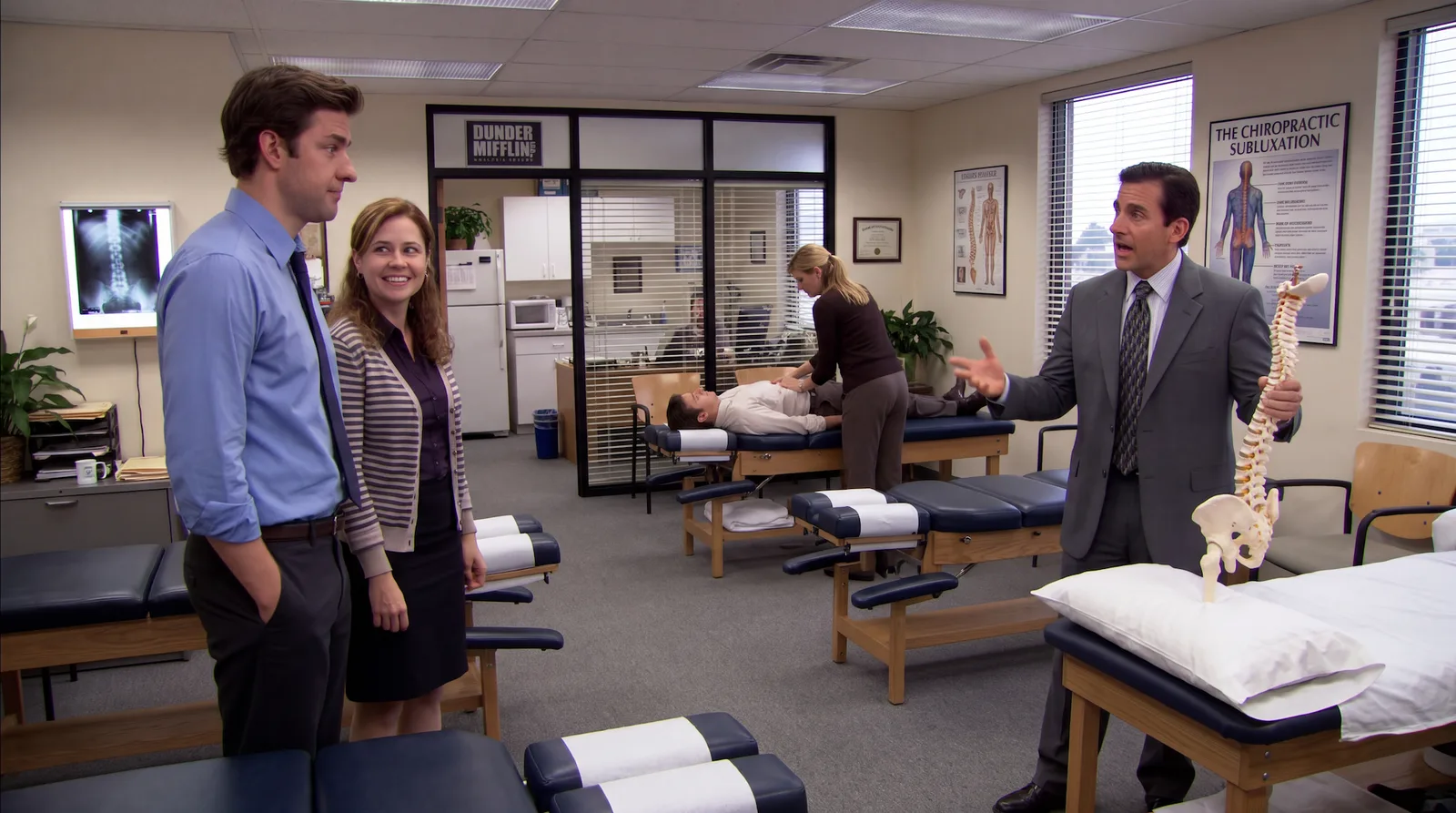 The grand tour. Patients love it. The front desk still hasn’t asked anyone for a review.
4. Bring Stanley Back
Stanley was a great patient. Reliable, punctual, never once asked a follow-up question. Then one day he simply stopped coming. No cancellation, no complaint, no forwarding address. He is, as far as anyone can tell, doing a crossword somewhere and waiting for Pretzel Day.
Stanley is not coming back on his own. Stanley does not do anything on his own that he hasn’t been specifically asked to do, in writing, at a reasonable hour.
Every practice has a drawer full of Stanleys: patients who liked you, finished their visits or drifted off, and simply haven’t thought about you since. They are the cheapest patients you will ever get back, because they already know where you are and they already liked you.
What brings Stanley back is email. A useful monthly newsletter that keeps the office on his mind, a friendly “we miss you” note after a few months of silence, and a short reactivation sequence with an easy way to book. No guilt, no pressure. Stanley responds poorly to pressure. Here’s how to nurture your patients with email marketing.
5. Everywhere, Not WUPHF
Ryan, still in the parking lot, has a second idea. What if every message the practice sends went out on every channel at once? A reminder about Tuesday’s appointment would arrive as a text, an email, a phone call, a social post, a fax and a desktop pop-up, all in the same second.
We know this idea. It was called WUPHF, and it did not go well.
Here’s the funny part: Ryan isn’t totally wrong that you should be everywhere. Patients today find a practice on Google, check its reviews, see it on Facebook, get a postcard, hear a friend mention it and then book. Being visible in all those places helps. But being everywhere well means each channel does its own job, with the right message, at a pace that feels normal. Blasting the same thing everywhere at once doesn’t make you omnipresent. It makes you the reason people mute their phones.
If you want the version that works, read our piece on omnipresent marketing for chiropractors. Ryan has been asked to read it too. He says he will. He won’t.
6. Stop Pricing Like the Paper Company
Remember when Michael started his own paper company and priced everything so low that every sale lost money? The customers loved it. The math did not. The more they sold, the faster they went under, and nobody in the van could explain why.
Michael has brought this exact energy to his new patient special. He’s advertising a first visit for less than the cost of the parking validation. The phones are ringing off the hook, the schedule is packed with bargain hunters, and the practice is somehow poorer every week. Very few of them come back for a second visit.
A new patient special should get the right people through the door, not every person in Lackawanna County who loves a deal. Price it so it brings in patients who are a fit, cover your costs and set clear expectations about what happens after the first visit. We dug into that tradeoff in new patient special pricing: volume vs. quality.
(Dwight, who is now in charge of front desk policy, has proposed solving this with a 47-page cancellation policy, a no-show fine schedule and a laminated warning card for every chair. We admire the commitment. We have asked him to keep it to one friendly paragraph and an automatic reminder text.)
Bonus: The Dundies
Here’s the one thing Michael already gets right, and we’d like him to keep it.
Every year he throws the Dundies. In the new practice, they’re a patient appreciation night: snacks, a slideshow, homemade trophies and award categories that make no sense. Most Likely to Arrive Early. Best Waiting Room Small Talk. Longest Running Fantasy Football Grudge.
It’s ridiculous, and it works, because patients who feel appreciated stick around and bring their friends. Our only notes: invite patients to bring a guest, collect the guests’ contact info, follow up the next day, check your state’s rules before giving anything away for free, and keep the awards about the patients’ personalities, never their care. And please, Michael, no singing. Or a little singing. One song.
Where This Leaves Scranton
Michael Scott Chiropractic doesn’t need a new personality. It needs a website that books visits, a front desk that asks for reviews, a referral system that turns charm into new patients, emails that bring Stanley back, a presence everywhere that doesn’t feel like WUPHF, and a new patient special that doesn’t sink the ship.
Kevin has volunteered to track the numbers on all of it: new patients, where they came from, reviews per month, how many lapsed patients rebooked. He has built a spreadsheet. It has a tab for chili. We’re keeping an eye on it.
If any of this sounds a little too familiar, it’s fixable, and usually faster than you’d think.
Not in Scranton? Book a call. We’ll look at your practice and show you which of these six strategies would move the needle first.
This is a parody written for fun. CHIROBASIX isn’t affiliated with, or endorsed by, The Office, NBC or NBCUniversal.
Keep reading

Chiropractic Logo and Branding: How to Build a Brand Patients Remember
How to build a chiropractic brand patients remember: logo types, the clichés to avoid, colors, fonts, naming, trademark basics, a brand kit checklist and how to choose a designer.
Chiropractic Review Request Templates: 30+ Texts, Emails and Scripts
A copy-paste library of chiropractic review request templates: in-office scripts, texts, reminders, emails, QR card copy, Spanish versions, and a what-not-to-say table.

How to Grow a Chiropractic Practice: 29 Proven Ideas (2026)
Growing a chiropractic practice takes more than marketing. Here are 29 ideas across every growth lever, from the phone and the report of findings to retention, team, KPIs and a second location.
Want this kind of strategy built for your practice?
Book a free consultation. We'll audit your current marketing and map out the omnipresence plan for your local market.
Book A Free Consultation