

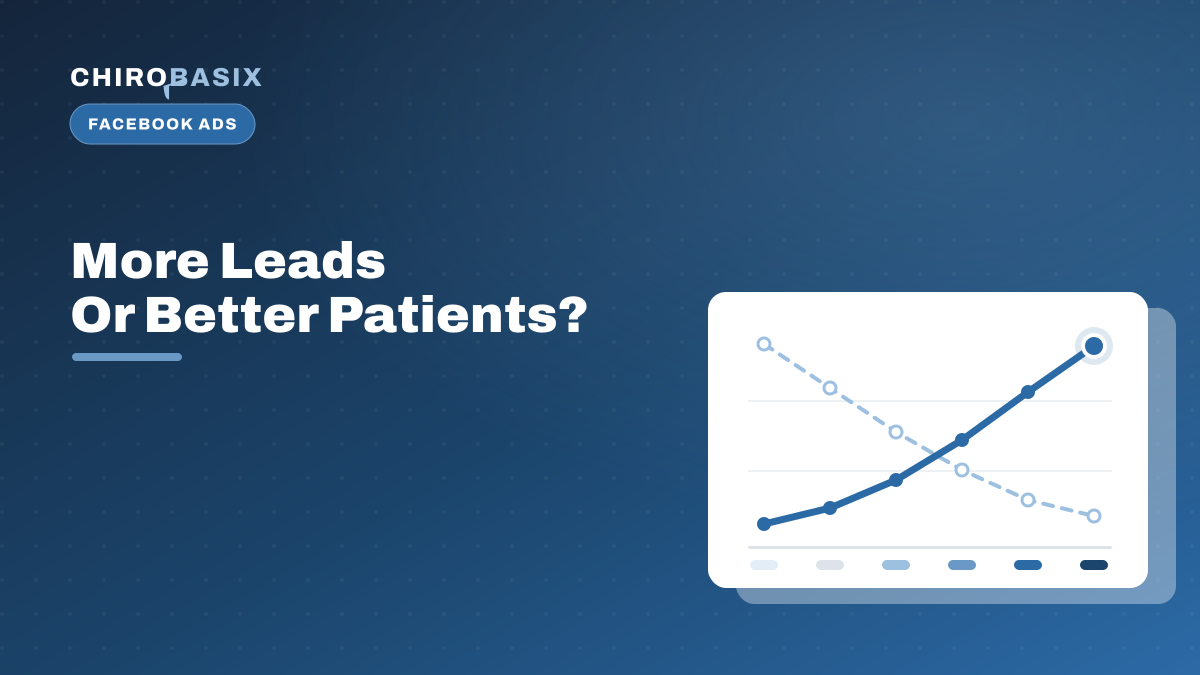
Facebook lead quality is how likely a lead from your ad is to answer the phone, book an appointment, and actually show up. For chiropractors, it is controlled mostly by friction: how much effort your form asks for. Less friction brings more leads that cost less. More friction brings fewer leads, but far more of them become patients.
You know the weekend I’m talking about. The ads ran, the dashboard lit up, and Monday morning your front desk has 40 new leads waiting.
By lunch they have dialed every single one. Voicemail. Voicemail. A number that doesn’t exist. Someone who says, “I don’t remember filling anything out.” A handful book. Fewer show up.
Ads Manager says the campaign is working. Your schedule says it isn’t. And your front desk is quietly starting to hate Facebook.
That gap, between leads that look great in a report and patients who actually walk through your door, is what this article is about. And here’s the part most practices miss: the fix usually isn’t a better ad. It’s a better form.
TL;DR: Every step you add between “I’m interested” and “I’m booked” costs you some leads and buys you better ones. We lay that out as a 6-step friction ladder, from Facebook’s two-tap Instant Forms up to a landing page that takes a payment to book. There is no single right step. The right one depends on how fast your team follows up, how full your schedule is, and what your offer costs. Pick a step, measure cost per patient who shows, and move one step at a time.
Why Cheap Leads Get Expensive
Cost per lead is the number everyone watches. It’s also the wrong number.
A lead that never answers didn’t save you money. You paid for it, and then you paid your front desk to chase it. Multiply that by a few dozen and you’ve burned a Monday.
Here’s a quick example. The numbers are made up, but the math is real. Picture two campaigns:
- Campaign A brings in leads at $8 each, and your team books one out of every ten. That’s $80 per booked patient.
- Campaign B costs $25 a lead, but half of them book. That’s $50 per booked patient.
Campaign A looks three times cheaper. Campaign B is actually the better deal, and it doesn’t wear out your staff on the way there.
The costs that don’t show up in Ads Manager are the ones that hurt:
- Staff hours spent calling people who were never going to come in.
- No-shows holding appointment slots a real patient could have used.
- Morale. A team that spends all day getting hung up on stops believing the marketing works.
The number that matters is cost per new patient who shows up. If you want to see what that looks like for your own practice, run it through our chiropractic marketing ROI calculator.
This is the same trade-off you make when deciding how you price your new patient special. A lower price brings more people in, a higher price brings more committed ones. Price is one lever. The friction in how people sign up is the other.
Friction Is a Dial, Not a Mistake
If you’ve read much marketing advice, including a lot of ours, you’ve heard “remove friction.” Make it easy to book. Put an online booking calendar on your website. Don’t make people jump through hoops.
For someone who searched Google for “chiropractor near me,” that advice is exactly right. They are already looking for you. Every extra step just gives them a reason to call the next office on the list.
Facebook is different. Nobody opens Facebook to find a chiropractor. They’re scrolling past their cousin’s vacation photos, and your ad interrupts them. When you give that person a form they can submit in two taps, you catch the genuinely interested and the mildly curious and the people who tapped by accident.
So friction isn’t good or bad. It’s a dial:
- Turn it down where intent is already high (Google, your website, referrals).
- Turn it up as a filter where intent is low (social media ads).
The 6-Step Friction Ladder
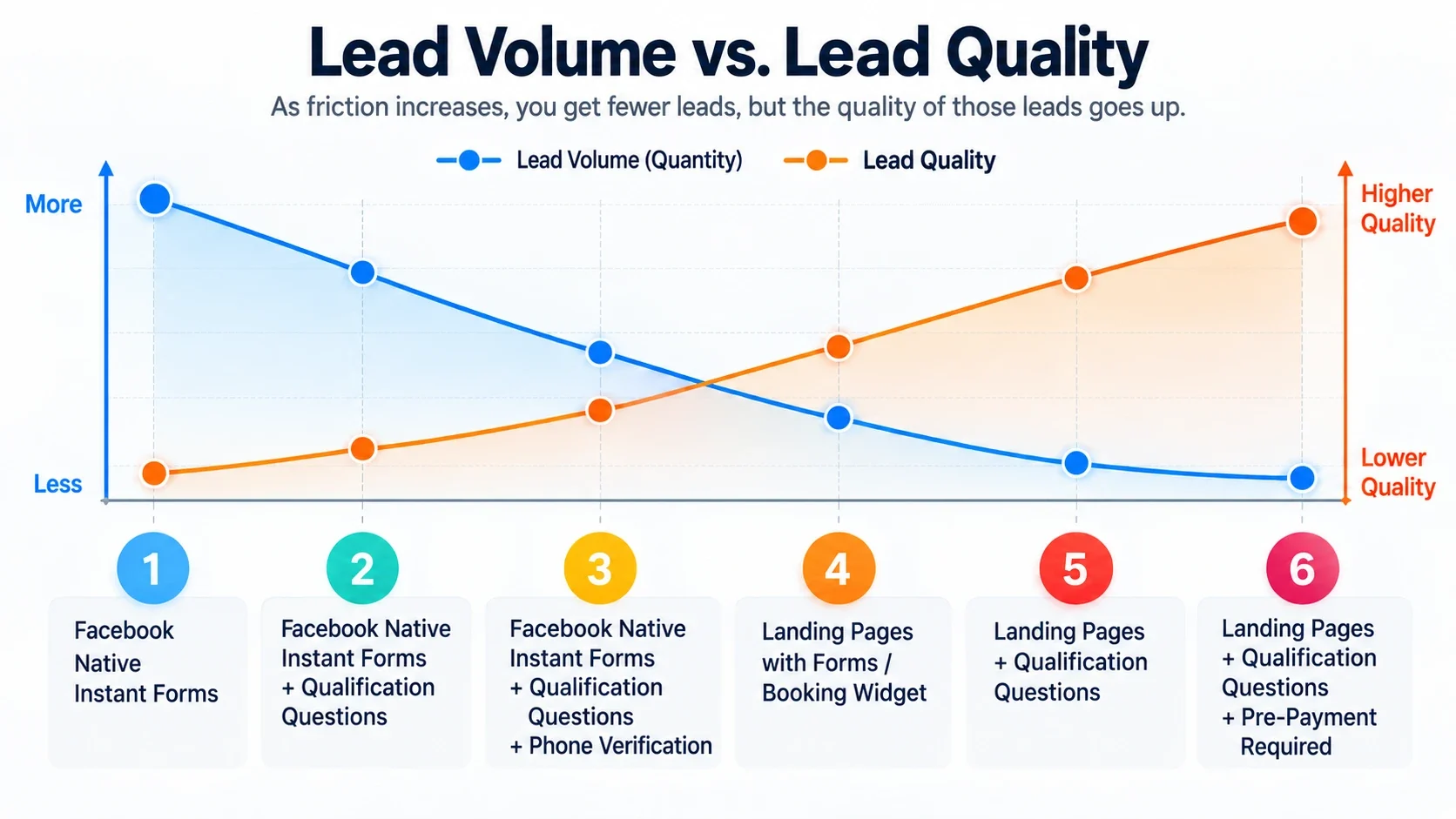
Here’s the whole idea on one page. Each step up the ladder asks a little more of the person, which means fewer leads, but better ones.
| Step | What the person does | What your front desk gets |
|---|---|---|
| 1. Instant Forms | Taps twice, never leaves Facebook | The most leads, the lowest intent |
| 2. + Qualification questions | Answers a few questions about their pain | Fewer leads who have thought about it |
| 3. + Phone verification | Confirms their number with a text code | Real, reachable phone numbers |
| 4. Landing page | Leaves Facebook, reads your page, fills out a form or picks a time | People who chose to learn more |
| 5. Landing page + questions | Answers questions before they can book | Pre-screened bookings |
| 6. Landing page + pre-payment | Pays to reserve their visit | The fewest, most committed patients |
1. Facebook Instant Forms
Facebook’s built-in lead forms come pre-filled with the person’s name, email, and phone number. They tap twice and they’re done, without ever leaving the app.
That’s why they produce the most leads at the lowest cost. It’s also why some people won’t remember submitting one by the time you call.
Instant Forms can absolutely work for a chiropractor, but only with one condition: someone calls every lead within minutes, not hours. The longer a lead sits, the colder it gets. If your team can’t guarantee that, look at speed-to-lead follow-up before you blame the ads. We cover the basics of setting up your Facebook lead form in our full guide.
2. Instant Forms + Qualification Questions
Add one to three questions that make the person stop and think. What’s bothering you? How long has it been going on? Have you seen a chiropractor before?
Questions like these do two jobs. They filter out people who were just tapping through, and they hand your front desk a head start on the conversation. It’s the same idea as using a short health survey to filter tire kickers.
Meta also offers a “higher intent” form type that adds a review screen, so the person has to confirm their details before submitting. That one extra tap weeds out a lot of accidental submissions. It only runs on mobile feeds, which is where most of your audience is anyway.
A note if you’ve read our older guides: we used to recommend the “More Volume” form type. That still makes sense if a real person calls every lead within a few minutes. If they don’t, higher intent is the safer default.
3. Instant Forms + Qualification Questions + Phone Verification
Meta’s SMS verification sends a one-time code to the person’s phone, and they have to enter it before the form will submit. The phone number field has to be required for this to work, and it needs a mobile number, not a landline.
This is the step that kills “the number you have dialed is not in service.” It filters out fake numbers and typos.
Be honest with yourself about what it doesn’t do, though. A verified number is a real number. It’s not a promise the person will pick up. It stops the dead-end calls, not the voicemails.
4. Landing Page with a Form or Booking Widget
This is the biggest single jump on the ladder, because the person leaves Facebook. The page has to load, they have to read it, and they have to decide.
That sounds like a lot of friction, and it is. But look at what you get in return. On your own landing pages you control everything: the message, your reviews, a video of you explaining the visit, the exact details of the offer, and a calendar where they can pick their own time. People who make it through that page already know what they’re signing up for.
Pair it with a booking calendar and automated lead follow-up so nobody who books falls through the cracks.
5. Landing Page + Qualification Questions
Same as step four, but the person answers a few questions before the calendar appears.
This is the step for a practice with a tight schedule, where every open slot matters and a no-show genuinely costs you. You’ll get fewer bookings, and more of them will be the right fit.
6. Landing Page + Booking + Qualification Questions + Pre-Payment
At the top of the ladder, the person pays to reserve their new patient visit, either in full or as a deposit.
This brings the fewest leads of any step, and the most committed ones. When someone has already paid, they tend to show up. It pairs naturally with how you price your new patient special, because the price you charge up front is part of the friction.
One important caution: rules on advertising discounted services, and on refunds, vary from state to state. Check with your state board before you require payment up front.
Instant Forms vs. Landing Pages: The Biggest Jump
If you only take one decision from this article, make it this one. The move from step three to step four changes more than any other step.
| Instant Forms | Landing Pages | |
|---|---|---|
| Where they stay | Inside Facebook | On your website |
| How much they type | Almost nothing, it’s pre-filled | Their details, maybe some answers |
| What you control | A headline and a few questions | The whole message, reviews, video, offer details |
| Booking | Your team calls to book | They can pick their own time |
| Lead volume | Higher | Lower |
| Lead quality | Lower | Higher |
| Best when | You call leads back within minutes | Your team is busy, or leads wait until tomorrow |
Neither one is wrong. Instant Forms are a volume play that depends on speed. Landing pages are a quality play that depends on a good page.
Which Step Is Right for Your Practice?
There’s no universal answer, but there are honest questions that point you to the right step:
- How fast does your team call new leads? If a real person calls within five minutes, you can live lower on the ladder. If leads sit until tomorrow, move up.
- How full is your schedule? Wide open, lean lower and fill the book. Nearly full, move higher and protect your time.
- What does your offer cost? A low-priced special attracts deal seekers, so it usually needs more friction to balance it out.
- How much can your front desk handle? Forty leads a day is only good if someone can actually call forty people.
Then move one step at a time. Change one thing, give it a few weeks, and compare cost per new patient who shows up. Not cost per lead.
Friction is also only one lever. The other is who sees your ad in the first place. Showing an offer to a cold audience will always attract more tire kickers than showing it to people who already know you. That’s why we lean so hard on warming up your audience before you make the offer, usually with an educational video retargeting funnel. Warm audience plus the right amount of friction is where Facebook ads start paying off.
It’s the same thinking behind how Spinal Rehab of Lake Geneva tripled its qualified new patients, with a program built around quality instead of raw lead volume.
What to Track
You can’t pick the right step without watching the right numbers. Track every lead through five stages:
- Leads: how many people submitted.
- Reached: how many your team actually spoke to.
- Booked: how many scheduled a visit.
- Showed: how many walked in.
- Started care: how many became real patients.
Then divide your ad spend by each one. When you move up a step, your cost per lead will almost certainly go up. What you’re watching for is your cost per patient who shows and starts care going down.
Chiropractic Facebook Lead Quality FAQs
Why are my Facebook leads so low quality? Usually because the form is too easy. People on Facebook aren’t looking for a chiropractor, so a two-tap form catches the curious along with the serious. Adding the right amount of friction filters for people who actually intend to come in.
Should chiropractors use Facebook Instant Forms or landing pages? Instant Forms bring more, cheaper leads with lower intent. Landing pages bring fewer leads who are more likely to book and show. If your team calls every lead within minutes, Instant Forms can work. If leads wait until tomorrow, a landing page is usually the better bet.
What is Meta’s higher intent lead form? It’s an Instant Form type that adds a review screen, so people confirm their details before submitting. That extra step filters out accidental and half-interested submissions. It trades some volume for quality, and only runs on mobile feeds.
How do I stop fake leads from Facebook ads? Turn on Meta’s SMS verification, which texts a one-time code to confirm the number before the form submits. It filters out fake and mistyped numbers, but it won’t guarantee the person answers, so fast follow-up still matters.
Should I require pre-payment for a new patient special? Pre-payment brings the fewest leads but the most committed ones, and it can cut down on no-shows. Rules on advertising discounted services and on refunds vary by state, so check with your state board first.
Will adding friction raise my cost per lead? Yes, almost always, and that’s the point. Fewer people finish a harder form, so each lead costs more. Judge the campaign by the cost of a new patient who actually shows up, not by the cost of a single lead.
Get Started
The right amount of friction isn’t a guess. It comes from knowing your follow-up speed, your schedule, and your numbers, then adjusting one step at a time until the leads coming in look like the patients you want.
That’s exactly what we do every day with Facebook ads for chiropractors. If your front desk is tired of chasing leads that go nowhere, book a free call and we’ll look at where your practice sits on the ladder, and which step will get you more patients who actually show up.
Keep reading
AEO & GEO for Chiropractors: How to Get Your Practice Recommended by AI
AEO and GEO are two names for one goal: getting your practice cited and recommended inside AI answers. Here's the practice-focused hub guide, built on your SEO foundation.
GEO vs SEO for Chiropractors: What's the Difference?
SEO gets your practice ranked. GEO gets it cited inside the AI answer. Here's how they differ, where they overlap, and why chiropractors need both in 2026.
How to Get Your Chiropractic Practice Cited by ChatGPT & AI Search
AEO and GEO are two names for one job: getting your practice cited inside AI-generated answers. Here's the practical how-to for chiropractors: the six signals that earn AI citations, step by step.
Want this kind of strategy built for your practice?
Book a free consultation. We'll audit your current marketing and map out the omnipresence plan for your local market.
Book A Free Consultation